Secure Tomorrow

Small Business, Big Impact

· 2 min read

Each May, the United States celebrates National Small Business Month, ...

The Key to Smarter Investing

· 2 min read

A risk profile, often determined through a risk profile assessment, is...

The Financial Decisions That Matter Most

· 2 min read

Financial stress is extremely common today. According to recent survey...

Experience In Demand: The Aging Workforce

· 2 min read

Experience In Demand: The Aging Workforce Wendell Brock Mar 10 2 min r...

Marginal vs. Effective Tax Rates

· 2 min read

Marginal vs. Effective Tax Rates Wendell Brock Mar 10 2 min read When ...

AI Doesn’t know You, But It’s Advising You Anyway

· 2 min read

AI Doesn’t know You, But It’s Advising You Anyway Wendell Brock Feb 4 ...

Gold, Silver, and Their American History

· 2 min read

Gold, Silver, and Their American History Wendell Brock Jan 22 2 min re...

The Economics Of Disaster

· 2 min read

The Economics Of Disaster Wendell Brock Dec 17, 2025 2 min read Natura...

The Shutdown No One Asked For

· 1 min read

The Shutdown No One Asked For Wendell Brock Dec 3, 2025 2 min read In ...

Protect What Matters Most

· 2 min read

Protect What Matters Most Wendell Brock Oct 21, 2025 2 min read You pr...

Secure Tomorrow

Small Business, Big Impact

Posted by Wendell Brock

May 4, 2026 3:14:46 PM

Each May, the United States celebrates National Small Business Month, honoring the entrepreneurs and local companies that power communities nationwide. While large corporations often dominate headlines, small businesses form the backbone of the American economy, driving innovation, job creation, and community development.

Read More

Topics: small business, community, local

The Key to Smarter Investing

Posted by Wendell Brock

May 4, 2026 3:08:46 PM

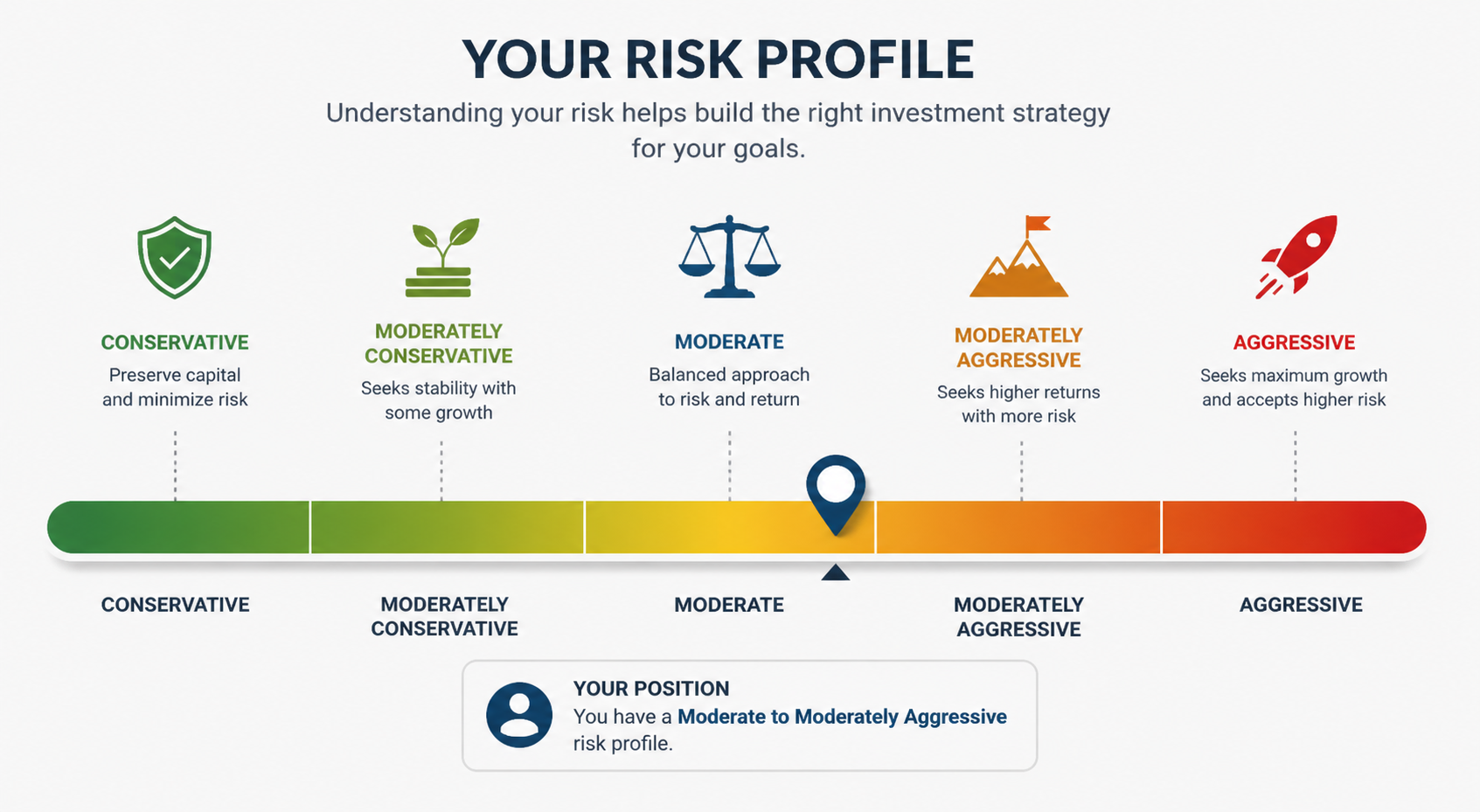
A risk profile, often determined through a risk profile assessment, is a foundational concept in financial planning and investing. Simply put, a risk profile is a comprehensive evaluation of an individual’s willingness and ability to take on investment risk. It combines emotional factors (risk tolerance) with financial realities (risk capacity), helping investors understand how much uncertainty or potential loss they can reasonably handle.

Read More

Topics: Smart, Risk Profile, investing

The Financial Decisions That Matter Most

Posted by Wendell Brock

Apr 27, 2026 3:22:51 PM

Financial stress is extremely common today. According to recent surveys, 66% of Americans live paycheck to paycheck, and nearly 65% do not have enough savings to cover a $1,000 emergency, highlighting how fragile many household finances are.

Read More

Topics: planning, Finances

Experience In Demand: The Aging Workforce

Posted by Wendell Brock

Mar 10, 2026 12:00:00 AM

Experience In Demand: The Aging Workforce

  • Wendell Brock
  • Mar 10
  • 2 min read

If your team is adding a new employee this year, don’t be surprised if your newest coworker remembers the screech of dial-up internet or the thrill of an AOL “You’ve got mail” alert. The average age of new hires in 2025 climbed to around 42, up from 40½ in 2022 and 40 in 2016, according to workforce data firm Revelio Labs.


This shift reflects an aging workforce and employers’ growing focus on experience in a rapidly changing economy. Hiring patterns have diverged sharply by age: since 2022, the share of workers 25 and under has fallen, while hiring of workers 65 and older has surged. Entry-level inflows are down significantly   compared with pre-pandemic levels, even as older adults return to (or remain in) the workforce in record numbers.


Customer-facing roles such as sales, real estate, and office support have also skewed older, with average ages rising notably over the past decade. Traditionally, tight labor markets boost younger hiring, but today employers often prefer candidates who can “hit the ground running,” especially as technology and AI reshape job requirements. Experience, institutional knowledge, and adaptability have become even more valuable.

Demographics are a major driver. Americans are living longer, staying healthier, and often delaying retirement due to financial uncertainty. Many also simply want to stay engaged.

Workers 55 and older have become the fastest-growing labor force segment and now make up a substantial share of total employment. Industries like utilities, manufacturing, and wholesale trade rely heavily on seasoned employees with long tenure and specialized skills.

An older hiring profile offers both advantages and challenges. Experienced workers bring stability, mentorship, and deep expertise, strengthening teams and supporting knowledge transfer. Multigenerational workplaces thrive when collaboration is encouraged.


But the shift can tighten entry-level pipelines. In fields where experienced employees hold roles longer, younger workers may see fewer openings or slower advancement. Some industries could face future skills gaps if younger talent doesn’t enter at scale.


Meanwhile, concerns about age bias persist. Many older job seekers still worry about discrimination, even as employers increasingly depend on their skills.


The rise in older new hires reflects demographic realities and strategic choices. Employers are balancing immediate productivity with long-term workforce planning, often leaning toward experience during uncertain times. For younger workers, this means building skills early and showing readiness. For organizations, it highlights the need to preserve entry pathways while leveraging seasoned talent.


Today’s workplace is fully multigenerational. Companies that intentionally support collaboration across age groups will be best positioned to sustain strong talent pipelines and remain competitive.


Photo by: KIMDAEJEUNG


2 views
0 comments
Read More

Marginal vs. Effective Tax Rates

Posted by Wendell Brock

Mar 10, 2026 12:00:00 AM

Marginal vs. Effective Tax Rates

  • Wendell Brock
  • Mar 10
  • 2 min read

When people talk about taxes, phrases like “I’m in the 22% bracket” or “I pay about 13% in taxes” often get used interchangeably. But those statements describe two very different concepts: marginal tax rate and effective tax rate. Understanding the difference between them is essential for smarter financial planning, clearer budgeting, and avoiding costly misconceptions about how taxes actually work.


The U.S. tax system is progressive, meaning income is taxed in layers, or brackets. As your income increases, only the portion that falls into a higher bracket is taxed at a higher rate—not your entire income. This is where marginal and effective tax rates come into play.


Your marginal tax rate is the tax rate applied to your last dollar of income. In other words, it’s the rate you’ll pay on your next raise, bonus, or additional income. For example, if you fall into the 22% federal tax bracket, that does not mean all your income is taxed at 22%. It means the top portion of your income, the amount that spills into that bracket is taxed at 22%.


This rate matters most for decision-making. When evaluating whether to take on extra work, sell an investment, or convert retirement assets, your marginal tax rate helps estimate how much of that additional income you’ll actually keep after taxes.


Your effective tax rate, on the other hand, tells a different story. This is your average tax rate across all your taxable income. It’s calculated by dividing the total tax you paid by your total income from all sources. Because income is taxed progressively, your effective rate is almost always lower than your marginal rate.


For example, someone earning $120,000 as a married couple filing jointly might fall into the 22% marginal bracket. However, after accounting for lower brackets and deductions, their effective tax rate could be closer to 13–14%. This number is helpful for understanding your overall tax burden, comparing year-to-year changes, and planning household cash flow.


Confusion between these two rates is common and it often leads to bad financial assumptions. Many people believe that earning more money will push all their income into a higher tax bracket, resulting in less take-home pay. That’s simply not how the system works. Only the income above each threshold is taxed at the higher rate, which means earning more almost always results in more net income, not less.


Deductions can further complicate but improve the picture. Taxpayers can reduce taxable income by choosing between the standard deduction or itemized deductions, whichever is higher. For most people, the standard deduction makes sense because it’s simple and generous. For others especially homeowners, high charitable givers, or those with large medical expenses itemizing may lower their tax bill even more.


The key takeaway is this: your marginal tax rate affects future decisions, while your effective tax rate reflects reality. One tells you what happens to the next dollar you earn; the other tells you how much you actually paid overall.

Understanding the difference helps you make better choices, avoid unnecessary fear around tax brackets, and plan with confidence. Taxes may be complicated but knowing how these two rates work puts you firmly back in control of the conversation and your financial strategy.


Read More

AI Doesn’t know You, But It’s Advising You Anyway

Posted by Wendell Brock

Feb 4, 2026 12:00:00 AM

AI Doesn’t know You, But It’s Advising You Anyway

  • Wendell Brock
  • Feb 4
  • 2 min read

Artificial intelligence has quickly become a popular source of financial guidance, with tools like ChatGPT, Microsoft Copilot, and Google Gemini increasingly used for budgeting, investing, tax questions, and retirement planning, especially among younger generations.


The appeal is understandable: AI is fast, free, nonjudgmental, and available 24/7, and in just a few years it has gone from a novelty to being treated by many as an authority on personal finance. However, research and real-world experience show that relying on AI for financial advice can carry serious and sometimes costly risks.

Multiple studies find that AI systems frequently produce inaccurate or misleading information. One major analysis found that nearly 45 percent of AI-generated answers contained significant errors, outdated details, or fabricated information known as “hallucinations,” while other research shows AI-powered search tools return incorrect answers in up to 60 percent of queries. These issues are not rare glitches but structural limitations of large language models, which generate responses based on probability and patterns rather than verified, real-time facts.


When these errors affect financial decisions, the consequences can be immediate. A survey by Pearl.com found that about one in five people (27 percent among Gen Z users) who followed AI-generated financial advice lost at least $100. While that amount may seem modest, it reflects a broader pattern. In multiple studies, more than half of users  reported making a poor financial decision after acting on AI advice, including mistimed investments, flawed debt strategies, unexpected tax bills, and compliance mistakes.


Real-world examples reinforce these findings. Wealth Strategies Journal reported on a user who turned to ChatGPT to learn stock trading; although he initially made a profitable trade, he later lost money because the AI relied on outdated market data. This highlights a critical weakness of general-purpose AI tools: they cannot reliably access real-time financial information or adapt to rapidly changing markets.


Several structural issues explain why AI advice can be risky. Hallucinations allow AI to confidently present  incorrect information as fact, while generic, one-size-fits-all guidance fails to account for individual income, tax situations, risk tolerance, time horizons, or         emotional factors. Additionally, AI lacks emotional   intelligence and accountability, important elements in financial decision-making, especially during periods of market volatility.


There is also a behavioral risk. Many people turn to AI to avoid the embarrassment of asking “basic" financial questions, which can encourage learning but may also lead users to bypass qualified professionals and place undue trust in a tool never designed to manage real financial risk.


Financial professionals widely agree that while AI can be a helpful educational tool, it is not a replacement for human judgment, experience, or ethical responsibility. AI can serve as a starting point, not a final authority, and its guidance should always be verified and, when appropriate, reviewed by a qualified financial professional. As AI becomes more embedded in everyday life, critical thinking and human judgment remain essential because when it comes to your money and your future, convenience should never replace sound decision-making.


Read More

Gold, Silver, and Their American History

Posted by Wendell Brock

Jan 22, 2026 12:00:00 AM

Gold, Silver, and Their American History

  • Wendell Brock
  • Jan 22
  • 2 min read

For thousands of years, gold and silver have served as trusted forms of money, valued for their scarcity, durability, and universal acceptance. By the time the United States was founded, precious metals already lay at the heart of global commerce. America’s monetary story began with silver coins in colonial pockets, passed through a formal gold standard, and ultimately arrived at today’s world of fiat currency and modern investing.


Before the U.S. minted its own money, everyday transactions relied heavily on foreign silver coins, especially the Spanish dollar. Early experiments with paper money under the Articles of Confederation produced the infamous “Continentals,” which collapsed in value without precious-metal backing. The lesson was clear: stability mattered. When the founders designed a monetary  system, they anchored it to gold and silver.


That vision took shape with the Coinage Act of 1792, which established the U.S. Mint and defined the dollar in terms of both metals. This bimetallic system allowed citizens to bring gold or silver to the Mint for coinage. However, the fixed silver-to-gold ratio conflicted with market prices, causing gold to disappear from circulation, an early example of Gresham’s Law.


In 1834, Congress adjusted the ratio, bringing gold back while silver flowed out. Major discoveries like the California Gold Rush expanded metal supplies, and although bimetallism remained official policy, the U.S. increasingly functioned on a gold standard.

The Civil War disrupted that balance. To fund the conflict, the government issued greenbacks, America’s first true fiat currency, sparking inflation. After the war, officials worked to restore confidence in metal-backed money.


A decisive shift came in 1873 when free silver coinage ended, placing the U.S. firmly on a gold standard. Political backlash followed, famously culminating in William Jennings Bryan’s 1896 “Cross of Gold” speech. Gold ultimately prevailed, and the Gold Standard Act of 1900 made it official.


The gold standard supported rapid industrial growth until the Great Depression. In 1933, President Franklin D. Roosevelt suspended domestic gold convertibility and outlawed private gold ownership, revaluing gold and expanding the money supply. Gold continued to anchor the dollar internationally under Bretton Woods after World War II, but mounting deficits eroded confidence.


In 1971, President Nixon ended gold convertibility entirely, turning the dollar into a pure fiat currency. Inflation surged in the 1970s, and gold prices soared. When private ownership was legalized again in the mid-1970s, gold and silver entered the modern investment era.


Today, both metals trade freely through bullion, coins, and ETFs. Silver plays a growing industrial role, while gold remains a reserve asset for central banks. Even in a fiat-currency world, gold’s long history of preserving purchasing power continues to resonate.


Read More

The Economics Of Disaster

Posted by Wendell Brock

Dec 17, 2025 12:00:00 AM

The Economics Of Disaster

  • Wendell Brock
  • Dec 17, 2025
  • 2 min read

Natural disasters like wildfires, hurricanes, floods are becoming more frequent and intense, and their economic impact stretches far beyond immediate damage. In recent years, these disaster events have reshaped not only community resilience but national macro-financial trends.


From 1980 to 2024, the U.S. endured 403 weather and natural disasters, each costing at least $1 billion, amounting to a staggering $2.9 trillion in total damages. Bloomberg has reported that in just the first half of 2025, floods, fires, and storms caused over $101 billion in      economic losses.


How do disasters hit the Economy? We’ve seen the destruction of capital; physical assets like homes, factories, roads, and power infrastructure are destroyed or heavily damaged. That’s a direct hit to productive  capacity. When capital is lost, labor has less to work with, which reduces workers’ productivity and lowers GDP.


Disaster recovery demands large injections of Federal spending. In recent years, disaster-related federal  spending has soared. In fact, Bloomberg Intelligence  estimates that over $7.7 trillion of U.S. GDP growth since 2000 has been tied to recovery and resilience spending.

On the flip side, sectors like insurance, construction, self-storage, and energy infrastructure benefit from rebuilding. Bloomberg’s “Prepare and Repair Index,” which tracks companies tied to disaster recovery, has outperformed the S&P 500 by ~6.5% annually over the past decade.


At the local level, the effects of disaster are felt deeply. Disasters disrupt employment and business activity. Factories may halt, roads may collapse, and supply chains break, reducing economic output immediately. Poorer regions struggle most, while wealthier areas can mobilize resources to rebuild quicker,. Marginalized communities often lack the capital and insurance coverage to fully recover. Public infrastructure, such as schools or hospitals damaged in disasters, may not get rebuilt to previous levels. In some cases, populations shrink, as residents relocate permanently.


Beyond infrastructure, disasters inflict trauma, displace families, and degrade natural capital. Many of these losses aren’t captured in GDP: mental health, environmental degradation, and disrupted social networks fall through the cracks of traditional economic metrics.


“Recovery Booms” can be misleading. It’s tempting to say disasters are "good for the economy" because rebuilding creates work. But economists caution against this view. The broken window fallacy shows that destruction doesn’t create real wealth. Repairing      damage, like a broken window, stimulates spending but diverts resources from productive uses, meaning no net economic gain occurs. Rebuilding after disasters or crises may create visible activity, but it doesn’t replace what was lost or generate true growth wealth.


Even if GDP ticks up during recovery, that growth often masks destroyed value. Total output has declined, capital has been permanently lost, and long-term social costs remain.


As disasters intensify, policymakers and investors should rethink their priorities. Building resilient infrastructure, improving building codes, and expanding insurance access are no longer just moral or planning issues, they’re economic imperatives.


From a macro perspective, disaster risk is now a driver of growth in some sectors. But at the community level, resilience is a lifeline.


Photo by Chris Gallagher

Photo by Angelo Giordano


Read More

The Shutdown No One Asked For

Posted by Wendell Brock

Dec 3, 2025 12:00:00 AM

The Shutdown No One Asked For

  • Wendell Brock
  • Dec 3, 2025
  • 2 min read

In October 2025, the United States entered the longest federal government shutdown in its history after Congress failed to pass full-year appropriations for  fiscal year 2026. The lapse began on October 1 and dragged on for 42 days, 22 hours, and 25 minutes   before lawmakers finally reached a funding deal in mid-November.

The standoff centered on spending levels, with Senate Democrats rejecting a short-term Republican funding bill. Much of the dispute revolved around health-care funding, particularly ACA tax credits. Without a continuing resolution, all non-essential federal operations ground to a halt.


The economic fallout was immediate. Goldman Sachs estimated each week of the shutdown reduced annualized GDP growth by about 0.2 percentage points and cost roughly $15 billion in lost economic activity. The Congressional Budget Office projected permanent losses of $7–14 billion even after recovery. Consumer demand weakened as hundreds of thousands of workers missed paychecks, and uncertainty spread across industries dependent on federal contracts. Key programs, from CHIPS Act initiatives to semiconductor and quantum manufacturing, faced delays, according to Democratic lawmakers.


Roughly 900,000 federal employees were furloughed, with hundreds of thousands more working without pay as “excepted” personnel. Thanks to a 2019 law, most were guaranteed retroactive pay once the government reopened. Still, delays in economic data, passport services, and other federal functions eroded public confidence.


Shutdowns also tend to worsen the deficit. Restarting agencies and catching up on delayed work often  requires extra funding, meaning the government ultimately spends more than if operations had continued uninterrupted.


Congress finally approved a funding package on November 12, ending the shutdown. The agreement extended current spending through January 30, 2026, and fully funded three of the twelve appropriations bills, Agriculture; Military Construction & Veterans Affairs; and the Legislative Branch (naturally, the branch responsible for the shutdown ensured its own funding). The deal also reversed recent workforce cuts, halted further layoffs, and formalized back pay for furloughed employees.


In practical terms, the shutdown disrupted normal economic activity and cost taxpayers more money, all while federal employees endured what amounted to a 42-day paid vacation while Congress had a paid   temper tantrum. As David Wessel of the Brookings Institution observed, shutdowns inflict real-world economic damage far beyond political theater.


The 2025 shutdown serves as a reminder of how fragile political consensus can undermine economic stability, and how essential it is for Congress to do its job.


Read More

Protect What Matters Most

Posted by Wendell Brock

Oct 21, 2025 12:00:00 AM

Protect What Matters Most

  • Wendell Brock
  • Oct 21, 2025
  • 2 min read
 

You probably don’t think about it every day, but everyone has an estate—everything you own, from your home and savings to your favorite collectibles. The question is: what happens to all of it when you’re no longer around? That’s where estate planning comes in. Think of it as a way to ensure your wishes are honored and your loved ones are cared for, without leaving them to navigate a messy legal maze.


Estate planning isn’t just about a will. It’s a set of  documents that guide what happens if you can’t manage your finances or healthcare—or when you pass away. At a minimum, a solid plan includes a will, durable power of attorney, healthcare power of attorney, living will, and HIPAA authorization. Many people also use a revocable living trust to simplify things further. A will lays out your wishes and names an executor and guardians for minor children, but it doesn’t avoid probate—the public, court-supervised process that can slow asset    distribution and add stress to your family.


A durable power of attorney lets someone you trust handle financial matters if you’re incapacitated. Similarly, a healthcare power of attorney allows someone to make medical decisions on your behalf. A living will spells out your healthcare preferences, including end-of-life wishes, while a HIPAA form gives caregivers access to your medical information so they can make informed decisions.


For those wanting privacy and to avoid probate, a revocable living trust is a game-changer. Assets in a trust pass directly to beneficiaries without court involvement, and trusts can protect heirs from unnecessary stress or financial mismanagement. Families with larger estates or complex situations might also use irrevocable trusts, spousal lifetime access trusts (SLATs), or special-needs trusts to reduce taxes, protect assets, and manage distributions carefully.


Even if your estate is modest, planning matters. Joint   accounts, payable-on-death accounts, small estate affidavits, and annual gifting strategies can simplify transfers and reduce taxes. For anyone with minor children, having a plan is critical—without it, the state decides who cares for them and how your assets are  distributed.


The bottom line? Estate planning is about more than money—it’s about protecting loved ones and making your wishes clear. Regularly reviewing and updating your plan ensures it keeps up with changes in your life, finances, and the law. A well-crafted estate plan can prevent family disagreements, reduce stress, and provide peace of mind knowing everything is taken care of exactly the way you want.


Whether your estate is big or small, now is the time to make your plan. Work with an estate planning attorney to navigate legal and tax considerations and give yourself—and your family—the clarity and security they deserve.


Obviously these explanations are very general—each document has its own purpose and details. The key is getting this part of your financial plan checked off. We’re happy to walk through the documents and help you gather the information an attorney will need to draft them. Reach out and we’ll set up a time to make it happen.


Read More

About this blog

This is where you give the visitor a brief introduction to both this blog and your company. Keep the intro pithy and punchy.

Subscribe to Email Updates

Recent Posts