










Secure Tomorrow

Traditional Christmas Cookie Recipe

· 1 min read

Traditional Christmas Cookie Recipe Wendell Brock Dec 12, 2022 1 min r...

Time For an Income Tax Review

· 2 min read

Time For an Income Tax Review Wendell Brock Nov 10, 2022 3 min read Un...

Rising Global Food Prices Pose Risk For Food Industry

· 1 min read

Rising Global Food Prices Pose Risk For Food Industry Wendell Brock No...

Falling Labor Productivity

· 1 min read

Falling Labor Productivity Wendell Brock Sep 23, 2022 2 min read The m...

Put Your Profit First

· 2 min read

Put Your Profit First Wendell Brock Sep 16, 2022 2 min read When manag...

Life Insurance Awareness Month

· 2 min read

Life Insurance Awareness Month Wendell Brock Sep 9, 2022 3 min read Up...

Consumer Credit Usage Going Up!

· 1 min read

Consumer Credit Usage Going Up! Wendell Brock Aug 23, 2022 2 min read ...

Pay Yourself First

· 2 min read

Pay Yourself First Wendell Brock Aug 19, 2022 3 min read In a world of...

Tax Planning Strategies to Help Save You Money

· 2 min read

Tax Planning Strategies to Help Save You Money Wendell Brock Aug 16, 2...

Money Stress and Your Health

· 2 min read

Money Stress and Your Health Wendell Brock Jul 22, 2022 2 min read We ...

Secure Tomorrow

Traditional Christmas Cookie Recipe

Posted by Wendell Brock

Dec 12, 2022 12:00:00 AM

Traditional Christmas Cookie Recipe

  • Wendell Brock
  • Dec 12, 2022
  • 1 min read
 

Everyone loves cookies at the holidays, well, most everyone. Here's a fun traditional Christmas cookie recipe, just like Grandma used to make!

  Tr aditional Molasses Cookies


Ingredients:
 

¾ cup butter, softened

1 cup sugar

1 large egg

¼ tsp salt
½ tsp ginger
½ tsp cinnamon
2 tsp baking soda
¼ cup molasses
2 ¼ cups flour
sugar for dipping
 
Directions:
  Preheat oven to 350 degrees f.
 

Cream butter and sugar together. Add egg and mix until combined. Add spices and molasses and mix thoroughly. Add the flour and mix a final time until everything is well combined.

Spoon dough into balls and roll smooth. Dip the dough ball into the sugar and place on a baking sheet.
 
Bake about 9-11 minutes (time will vary based on your oven).
  E njoy! And remember to share some with your friends!


Read More

Time For an Income Tax Review

Posted by Wendell Brock

Nov 10, 2022 12:00:00 AM

Time For an Income Tax Review

  • Wendell Brock
  • Nov 10, 2022
  • 3 min read

Unbelievably, it’s almost the end of the year. Before you know it it’ll be Thanksgiving then Christmas, and in a blink it’ll be the new year and the end of the 2022 tax year. That makes now the perfect time to start going over and reviewing your tax information.

It’s always good to review your previous year’s tax return. Take note of any changes that have occurred since the last time you filed. Did you move, retire, switch jobs, or get married? Has your filing status or tax bracket changed? Each filing status comes with different tax bracket income thresholds, standard deductions, and eligibility of certain tax credits.

Tax deductions help to reduce your taxable income, which means you will have a lower tax bill, so you don’t want to miss out on any! However, you need to make sure you have proper paperwork. Having all your required documentation is necessary to claim your deductions and will help protect you if you get audited.

Take some time to find all the deductions you are eligible for, things like retirement contributions, educational expenses, medical bills, property taxes and mortgage interest, or charitable donations. Likewise, you want to be able to utilize any tax credits available to you. As with deductions, you will need to your documents in order to claim them. Planning ahead for the following year, if you don’t already, have a separate file for any paperwork or documentation relating to your taxes, this way you won’t miss any when it comes time to file.

Look back over your medical expenses for the year, they will only be eligible for deductions for the amount that exceeds 7.5% of your adjusted gross income. For example if your AGI is $65,000 and you had $8,000 in medical and/or dental expenses you would be able to deduct $3,125 (7.5% of $65,000 is $4,875. Take $8,000 expenses subtract $4,875 which equals $3,125 eligible for deduction). If you add all your medical expenses and they do not exceed the 7.5% threshold consider moving some dental/doctor visits, medical purchases or procedures to December in order to include them in the current tax year’s existing amount and give yourself that push over the 7.5% line. If you are nowhere near the 7.5% maybe consider the inverse and hold off on scheduling things until the new year, and make plans to maximize those expenses in the following tax year.

You will want to consider if your income will increase or decrease next year because it may change your tax bracket, which would change the percentages relating to your deductions. If you are looking at a significant increase, wait until the next year to take the deduction because it will be worth more as a percentage of the higher income. Likewise, if you will be making less money next year, you may want to accelerate purchases for the current year.

The end of the year is a great time to review your retirement plan. You may be eligible to deduct certain contributions to a traditional IRA. Pay attention to your annual contribution limits for accounts such as your 401(k) or 403(b).

As we round the corner into the next tax year make plans now so you can maximize your deductions and credits. You don’t want to leave yourself scrambling come April, you also don’t want to miss out on money you could be saving. As boring or redundant as it may seem, the best advice is always to plan ahead.


Read More

Rising Global Food Prices Pose Risk For Food Industry

Posted by Wendell Brock

Nov 3, 2022 12:00:00 AM

Rising Global Food Prices Pose Risk For Food Industry

  • Wendell Brock
  • Nov 3, 2022
  • 2 min read

In the U.S., as well as other advanced economies around the world, much of the public is not fully aware of the severity of the world’s hunger crisis. Not only has this crisis been prevalent, but it has increasingly worsened over the past 15 years.


Hunger and undernourishment had been quite high at the turn of the century, with the UN Food and Agriculture Organization reporting that 13.4% of the world and 32.2% of the least developed countries were undernourished. This share began to fall into the early 2010s and stabilized around 8.9% from 2012 to 2017. However, this improvement did not characterize much of the world. Even before the COVID-19 Pandemic, undernourishment rates rose in Sub-Saharan Africa, Latin America, the world’s least developed countries, and much more of the world.

Three factors behind recent rises in global hunger are skyrocketing food prices, the invasion of Ukraine, and the pandemic, which has changed the lives of almost everyone across the globe affecting those in already poor situations the most.

The UN Food and Agriculture Organization’s Food Price Index is a measure of change in food commodities, measured monthly based on international prices of meat, dairy, cereals, vegetable oil, and sugar. In 2016, this measure reached its lowest since 2009, a decline that had a very short stay. Not only did this index rise in the years up to 2020, but it also skyrocketed in 2021 and reached an all-time high in March 2022. At its peak just this year, the Food Price Index was more than double its value just 18 years sooner. Simply put, food prices are on a steep incline, reaching levels far higher than in other recorded years.

Food prices were not alone in raising global hunger; the COVID-19 Pandemic had extremely severe effects. In its breakout year, 2019-2020, the State of Food Security and Nutrition in the World reveals that about 160 million people fell into hunger, meaning 811 million people around the world regularly went to bed hungry, roughly one in every ten people. Not only that, but over 48 million people face emergency levels of hunger according to the World Food Programme (WFP). The Global Network Against Food Crises reports that the number of people facing acute food insecurity rose by 40 million people in 2020-2021, with an estimated 193 million people facing this extreme level of hunger in 2021.


Read More

Falling Labor Productivity

Posted by Wendell Brock

Sep 23, 2022 12:00:00 AM

Falling Labor Productivity

  • Wendell Brock
  • Sep 23, 2022
  • 2 min read

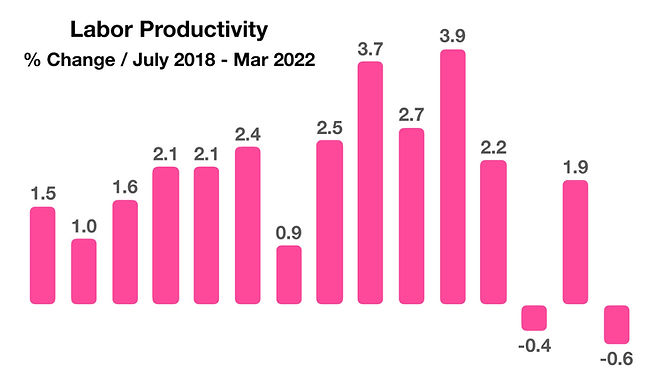
The most recent data released by the Labor Department revealed the largest quarterly drop in productivity since 1947, decreasing at an annualized rate of 7.5%. The drop in productivity was concurrent with the largest rise (11.6%) in labor costs since 1982. Both of these measures are also indicators of inflationary pressures for both companies and consumers. Many companies have been passing along higher costs to consumers, raising prices across the country faster than they have in the last 40 years. Eventually prices will be forced to level out because of competition between companies which will hold prices steady which will require these companies to absorb the higher costs. This could lead to decreased levels of hiring and lower wages as companies struggle to maintain profitability levels.

Data surrounding labor during the pandemic has been considered unreliable and inconsistent by many economists, meaning that the true effects of the COVID-19 pandemic and worker retention are still not certain. An essential data set is labor productivity, which is a measure of how efficiently companies are utilizing workers to produce products and services. This year, the largest four-quarter drop in labor productivity was observed since the fourth quarter of 1993 according to the Bureau of Labor Statistics, marking a historic decline in productivity. Another Labor Department report showed that jobless claims increased to 200,000 at the end of April, the overall number falling to 1.38 million, the lowest level since January of 1970.

Federal Reserve survey results, reported in the Fed’s Beige Book, have identified that a growing number of manufacturers and industrial companies are


increasingly moving towards automation, replacing previously desired workers with robotic gear. Rising wages and a dwindling labor pool have forced some companies to resort to machines instead of hiring workers.


Read More

Put Your Profit First

Posted by Wendell Brock

Sep 16, 2022 12:00:00 AM

Put Your Profit First

  • Wendell Brock
  • Sep 16, 2022
  • 2 min read

When managing your personal finances, we’ve talked about how important it is to pay yourself first-to put money into savings and then budget and spend what is left over. This creates a stable financial foundation to build from and rely on. When running a business, it’s important to follow the same principle and put your profit first. To have a successful business you need to make a profit. The strength and longevity of your business only lasts while it’s profitable. When you put your profit first you are determining to stay in business.

What does it mean to put your profit first? Traditional accounting says, expenses are deducted from sales and what is left over is considered your profit.

[Sales – Expenses = Profit]

But, just like paying yourself first, you take a percentage from each sale as profit and then use the remainder to pay for expenses.

[Sales – Profit = Expenses]

The overall goal is to develop a system that will build your business in a sustainable way in order to create long term success. Big picture, you would be grouping portions of the business sales and putting them into separate accounts. These will be comprised of profit, taxes, operating expenses, and owner’s pay. To make this system work you will put predetermined percentages of your sales into the various bank accounts starting with the profit account. How much you put into each account is determined by your Target Allocation Percentages (TAPs). This will be a shift from the Current Allocation Percentages (CAPs).


At first this may be a difficult thing to do, as it goes against the traditional model, but making the shift mentally and committing to the future of your business will make all the difference. When you consciously put money into your separate accounts it makes you more aware of how you are spending your money and helps you to spend more wisely. All of the accounts together can help give you a visual map of where your company is at and help you see how to get to where you want your company to go.

Perhaps the hardest part of this process is managing your expenses. Initially, you may need to cut back on your unnecessary expenses. This is a hard thing to do, but remember it’s a lot easier to cut expenses than it is to conjure up new sales. When making purchases or analyzing expenses the key thing is asking yourself, “do I (or my business) really need this?” If you’re able to determine that it isn’t necessary, or could potentially hurt your profits, cut it from your spending. It could take a few months to pay down debts, but by whittling down your expenses and being more conscientious you will start to build your cash reserves.

Eventually the goal is to learn how to enjoy saving your money as much, if not more, than spending it. When something makes you happy, you’ll keep doing it. Celebrate the moments when you opt out of spending unnecessary money, make it a big deal. Over time, you’ll build momentum and you will enjoy those moments and establish good, healthy money management.


Read More

Life Insurance Awareness Month

Posted by Wendell Brock

Sep 9, 2022 12:00:00 AM

Life Insurance Awareness Month

  • Wendell Brock
  • Sep 9, 2022
  • 3 min read

Updated: Sep 19, 2022


As of a 2021 only 52% of Americans have life insurance, according to LIMRA, and of those covered half are underinsured, meaning about three fourths of Americans will likely struggle to make ends meet in the wake of losing a loved one. With these numbers in mind, and since September is Life Insurance Awareness Month, I felt it an important topic to discuss. There are myriad reasons why so many people don’t have coverage. Some people might have other financial priorities, or they might not know how to go about finding the right coverage. Sometimes people are relying on a life insurance policy provided through their work and feel that is enough, neglecting the fact they will lose their insurance if they leave that company. Other people think life insurance costs more than it really does, or may have other misconceptions that prevent them from taking action. I’d like to shed a little light on this important aspect of financial planning and provide some insight so you can make the decision that is best for your family.

So, who needs life insurance? The short answer- everyone. Even the most wealthy need life insurance coverage. Whether you’re rich or poor, the government still needs to be paid, funeral expenses need to be covered, and life’s other demands will persist; if you don’t have life insurance your family may have to sell off possessions and other assets to cover final costs and maybe estate taxes. An old friend, who was a mortician by profession, told me once the thing he hated most about his job was putting a family in debt to bury a child. Having life insurance, and appropriate coverage, provides your family with options, giving them peace of mind and freedom from debt.

Life insurance is a bit of a misnomer because it’s not really about insuring your life, as much as actually insuring that your loved ones are taken care of after an unexpected death. Let’s face it, we’re all going to pass away sometime, and no one knows exactly when. It’s better to have the peace of mind knowing if death comes unexpectedly, stress over money won’t have to add to an already difficult time.

You spend your life working hard to provide for your family, you don’t want all your effort to be undone when you die. I’ve known people of all ages and in all different family circumstances, mature people, married with or without children (young or adults), young newly married with no kids or older people who are single that passed away unexpectedly. Every life has value to those left behind.

Once you decide to purchase life insurance you’ll need to figure out how much coverage your family will need. A general rule is to estimate ten to twenty times your annual earnings. To gain a better idea, it’s best to remember the why. Why will your family need this money, what financial obligations will they need to cover to maintain their security? This number may change over time, just as your life circumstances change. When you’re first starting out, you’ll want to make sure your mortgage, utilities, groceries, as well as other day to day expenses are paid for, maybe even the extra cost of your children’s education. Later in life, your focus might be on ensuring your spouse has a secure retirement. The goal is to have adequate coverage to pay all the known expenses and enough to cover the unexpected ones as well. This will provide stability and peace of mind. My father passed away when I was completing my second year of college. His life insurance policy helped my mother navigate the final expenses, and continue on. It provided some peace of mind that things would be o.k. And she did, she lived another 28 years.

There are many things in life to worry about, don’t let what will happen to your family after you pass be one of them.


Read More

Consumer Credit Usage Going Up!

Posted by Wendell Brock

Aug 23, 2022 12:00:00 AM

Consumer Credit Usage Going Up!

  • Wendell Brock
  • Aug 23, 2022
  • 2 min read

When pandemic assistance funds were first issued, a lot of people thought it was great to have the extra money. Unfortunately, there’s no such thing as free money. Now that those extra funds have been spent, and many people are making less or are unemployed, consumers are turning to savings and credit to pay for essentials. For those consumers that managed to save their stimulus funds, they’re finding the need to tap into those savings in order to keep up with inflation. Now many consumers have exhausted their cash reserves and turning to easy credit as the answer. This lead to consumer credit usage that escalated by $38 billion in April, bringing credit card debit to record levels.


Even though overall wages have risen roughly 6% over the past year according to Labor Department data, the increase is still not enough to keep up with an even higher inflation running at over 9.1%, the highest we’ve seen in America in 40 years. As households start to experience shortfalls, many resort to credit to meet their month-to-month expenses paying for things like bills, gasoline, and food.

Auto loans and credit card debt have seen the largest usage increases as tracked by the Federal Reserve over the past few months.

Mortgage debt has also risen, but mostly at the upper end of the credit score scale. Credit scores on newly originated mortgages remain relatively high, reflecting continuing high lending standards by lenders. The median credit score of newly originated mortgages was 776 during the first quarter of 2022. Analysts also believe that median credit scores may possibly begin to fall as consumers exhaust their cash savings and tap credit cards.


Image by Jaleigh Morris


Read More

Pay Yourself First

Posted by Wendell Brock

Aug 19, 2022 12:00:00 AM

Pay Yourself First

  • Wendell Brock
  • Aug 19, 2022
  • 3 min read

In a world of tightening budgets and higher interest rates consumers are saving less now than they were before the pandemic. What bill(s) do you pay first? As markets have pulled back, so have retirement fund values creating an uncertain future for many pre-retirees. More than ever it’s important to follow the “Golden Rule of Personal Finance.”

We’ve all heard of “The Golden Rule:” treat others how you want to be treated; this is a basic principle to live our lives by to make ourselves, and the world, better. In finance there’s also a basic principle that will make our finances and ultimately our lives better: Pay Yourself First.

The surest way of finding financial success is to save money first and spend what’s leftover. Make saving the new bill that gets paid first! Aren’t you the most important person you know? Afterall, you earned the money in the first place!

The general rule is to set aside 10 percent of your paycheck, then disperse the remainder into your budget. This takes a conscious effort and serious dedication, but if you remain consistent you will develop strong habits, creating a stable financial foundation to grow from.


Many people think that debt is the leading cause of financial distress, but the lack of savings is perhaps a more significant detractor from your financial success. There will always be unforeseeable events that require more from your budget than you were planning for. However, having a deep saving fund will create a solid foundation to build your financial success on and gives you financial resilience. It’s the old idea our grandparents lived by, live on less than you earn!

Saving first and spending what’s left over requires more self-discipline than it does to pay off debts. This strategy is one you play for the long game. Just like a muscle needs to be used regularly to become stronger, being exercised and put to use, so too with developing good saving habits, its muscle memory.

The thing that challenges us the most about not saving is there is always something else we may want. We can always justify our wants; our spending can always expand to our income whatever that may be. It takes discipline to say “No” to the latest shiny new object for sale.

FOMO, (fear of missing out) is a real thing in this world and many people buy things, well, just because. Our minds can play tricks on us making us think we need something that we really don’t. Remember money is emotional, it only does what our emotions/feelings tell it to do.

The real FOMO, most don’t address, is a FOMO about retirement. Missing out on that should be a real fear. There are so many people who are working during their retirement years, not necessarily because they want to, but because they must.

If you are not a ‘natural saver’, meaning that you’re a ‘spender’, then practice saving money. Start small by saving one percent of your paycheck for the next three months, then increase that amount a little more the next quarter. Keep increasing the savings amount each quarter to ten percent or more. To reduce the temptation to spend it, open an account someplace that is hard to get at the funds. Out of sight, out of mind. Then regularly transfer the designated amount to that account. Don’t worry about interest rates, the key is to save money. Growth on those funds can be addressed when you’ve saved a more substantial amount and the muscle memory is well exorcised.

Make a new goal: save more, spend less! Or, live on less than you earn!

photo by micheile dot com


Read More

Tax Planning Strategies to Help Save You Money

Posted by Wendell Brock

Aug 16, 2022 12:00:00 AM

Tax Planning Strategies to Help Save You Money

  • Wendell Brock
  • Aug 16, 2022
  • 3 min read

Proactive tax planning throughout the year is a smart way to help manage your tax burden. When planning ahead, you’re able to take full advantage of available tax credits and deductions. Don’t wait until the end of the year, or worse April 15th when taxes are due, to figure out what you can qualify for, or could have qualified for!

First, it’s important to know which tax bracket you’re in. There are seven federal income tax brackets: 10%, 12%, 22%, 24%, 32%, 35% and 37%. Your tax bracket is in part, based on how much money you make. The tax rates or brackets are progressive, the more taxable income the higher the bracket. There is another element to consider, and that is the kind of income. Earned income is taxed differently than investment income or capital gains, or retirement income.

There is a difference between tax deductions and tax credits. Deductions are specific expenses you have incurred throughout the year that can be subtract from your total income, netting the taxable income. Credits give you a dollar-for-dollar reduction in how much you owe in taxes. Both will reduce your tax bill and provide some great tax strategy options.

A common strategy is to utilize charitable donations. This one not only helps you, but can help others who are served by the non-profit you chose. Some common ways to make contributions may use specific legal structures, which include donor-advised funds, private foundations, charitable remainder trusts, stock donations, and IRA donations. There are multiple types of donations you can make, the type of asset being donated, (cash, goods, like-kind, appreciated stock, IRA funds, etc.) and the timing of the gift (present or future gifts) are all factors to consider when tax planning.


Having a health savings account (H.S.A.) is wise, not just for the savings aspect, but because your contributions go into your account pre-tax. It lowers your taxable income. When H.S.A. funds are used to pay for qualified medical expenses, there is no income tax paid on those funds. This can save a family lots of tax dollars. Why pay for medical expenses with after tax money when you can pay for it with tax free money?

Don’t confuse an HSA with a flexible spending account. Both are good, but they are used to pay for different expenses. Yes, some of the expenses do overlap, but if done right you can get twice the tax benefit.

Hopefully, everyone, no matter the age, is planning for retirement. You can structure retirement contributions in a way that helps in the long run known as tax optimization. Paying a little more now rather than a lot more later during retirement. There are so many retirement plan options; we’ll have to save that for another time.

Assets that are held for less than one year and sold, are subject to short-term capital gains, and taxed at the ordinary tax rate. Assets held longer than a year and sold, are taxed at long-term capital gain rates, which is different depending on your modified adjusted gross income. All unearned income, basically all investment income that is not W-2 income, over a certain income threshold is now subject to a 3.8% Medicare tax.

Tax laws/regulations (regs) are so complex it’s hard to get a clear picture of how different types of income interacts with the many regs. Earned income (W-2) is straight forward; when another type of income gets injected into tax return for a year or worse during retirement as a required minimum distribution (RMD). That may throw everything out of whack. Causing tax brackets to change, even to the point that the tax on the next dollar of income is taxed well above 50%. This is one reason why I use a tax map when working through issues with clients. It brings income and taxes together in a way that other strategies can be tested before making a potentially irreversible financial decision.


Image by Recha Oktaviani


Read More

Topics: taxes, Tax Savings, Income Taxes

Money Stress and Your Health

Posted by Wendell Brock

Jul 22, 2022 12:00:00 AM

Money Stress and Your Health

  • Wendell Brock
  • Jul 22, 2022
  • 2 min read

We all know that chronic stress can have some pretty severe effects on our health, from migraines, stomach aches, ulcers, and insomnia to more severe things including weight gain, depression, strokes, and heart attacks.


Back in December of 2020 CreditWise released a survey showing 73% of participants said worries about finances were their number one cause for stress. This beat out politics, work, and family stressors. In other words, the majority of people agree that money can be stressful! Losing a job, unexpected health problems, emergencies , or compounding debt can all lead to an increase in stress that can affect nearly every aspect of life. If left unchecked, the associated health problems have the potential to lead to high-cost medical bills, which then leads to even more financial stress.


So where does the cycle end? How can we overcome the stress associated with money? The best solution is to avoid unnecessary debt and stick to your budget or spending plan…but things don’t always go according to plan.


If you have encountered money problems, there’s a few things you can do to help alleviate some of your stress and start to work your way out of your financial woes. The first thing is to focus on the things that are within your control, such as sticking to a budget. If you spend your time focusing on the things outside of your control, you’ll only feel more overwhelmed and will lose the power you DO have.


Prioritize your bills and make sure you are paying the essentials first. Often you can talk to creditors and see if they are open to offering temporary solutions such as repayment freezes or not reporting missed payments to credit bureaus.


As soon as you are able, start saving money and then track your money-saving or debt payment progress. Having a visual reference can help keep you positive and focusing on your accomplishments.


If you have taken these steps and still feel like you’re losing ground, don’t be afraid to reach out to a financial advisor. Their experience and insight can help take some of the extra weight off your shoulders as well as developing a plan focused on your specific needs and goals.


It’s important to make your health a priority during times of stress. Stay active and keep your body moving. Exercise is one of the best ways to burn off stress and anxiety. Aim for exercising 3-5 times a week. Eat healthy meals with plenty of vegetables so your body is getting the needed nutrients. Above all, get adequate sleep. Let the worries go for the night and start fresh in the morning. Experts say sleep is the number one key to improving your health. When you get enough sleep, you’re able to think with a clear mind and keep much of the anxiety away.


Money stress doesn’t have to control your life or ruin your health. If you feel yourself becoming overwhelmed with worries about money and finances reflect on the things you can do, both with your money and your health, empower yourself and take action.


Read More

About this blog

This is where you give the visitor a brief introduction to both this blog and your company. Keep the intro pithy and punchy.

Subscribe to Email Updates

Recent Posts