Outside Economics

You Want a Better Investment Portfolio – Stop Chasing Performance

Posted by Wendell Brock, MBA, ChFC on Thu, Feb 04, 2016

It’s funny in conversation how many times people when asked what they are invested in talk about the hot stock fund from last year, which they were not in, but they are now! They just bought some! How many times have you found yourself looking at investment options find yourself looking at last year’s performance figures and say, “well that one did great, I think I will put some money there.”alton-towers-theme-park-closed-after-rollercoaster-crash.png

That is the wrong way to approach to investing – after all past performance is no indication of future results. The thought of being a Monday morning quarterback and calling the plays after the game is over just does not work well as an investment strategy. It may be better to simply keep a small amount of money in several funds and rebalance than think you can be a “crystal ball” investor and always pick the winners.

Its the ups and downs that get people sick - the roller coaster may be fun for a theme park, because it last for a couple minutes; an investment portfolio is suppose to last many years! That is a lot of ups and downs - particularly when chasing last year's best performer.

My friend, Dr. Craig Israelsen, PhD., wrote an article on Chasing Fund Performance and how impossible it is to select the winners regularly. However by keeping a diversified portfolio you will generally pick-up some winners and maybe some losers. Over the long term the winners will outweigh the losers and the portfolio will succeed.

In the article he describes what happens when portfolios chase the best asset class of last year. The growth rate of that model really drops when compared to other model portfolios. As Israelsen points out, it drops to 2.71% over a 15 year period.  This shows the value of a well-managed diversified portfolio. Using his 7Twelve portfolio over the same time period the 15 year annualized return would be 7.95%.

There are a ton of investment strategies that people use, if you are looking for a solid balanced portfolio, then I invite you to read the article – you can down load a free copy here.


REMEMBER:

Sam Ewing Said, "Inflation is when you pay $15 for the $10 haircut you use to get for $5 when you had hair."

Topics: asset classes, Performance, Investment strategies, investment portofolio

Strengthen Your Retirement Plan By Knowing Your Limits

Posted by Wendell Brock, MBA, ChFC on Wed, Jan 27, 2016

Here we are at the start of the New Year when folks get to review their contribution limits to their retirement plans. Below are the limits, however depending on the type of plans available and whether or not you are using a qualified or non-qualified plan determines your limits (certain non-qualified plans have no limits).

Often times non-qualified plans may yield more after tax income during retirement than qualified plans will, so it depends on if you want to pay taxes now or in the future. Perhaps, there is a balance between the two? That analysis should be performed.Retirement_plan_limits.jpgmaxw1000q90cci_ts20121025131619.jpeg

If you think taxes are going to go up in the future, consider using more non-qualified plans now. You can think about it this way: would you prefer pay taxes on the seeds you plant or all the vegetables you harvest? Both plans take time for money to grow!

For 2016, the elective contribution limit for employees who participate in 401(k)s will remain the same at $18,000 for the year. That is the amount that a saver can contribute annually on a tax-deferred basis, and it also applies to many plans offered by nonprofit and government employers. The catch-up contribution for employees age 50 and over will remain the same at $6,000, so someone in that age group could contribute a total of $24,000. (Matching contributions from employers do not count against this figure.)

IRA annual limits remain unchanged at $5,500, with the catch-up contribution for those 50 and over also flat at $1,000. Of IRA holders who contributed to their plan, 53.5% contributed the maximum annual amount, according to data from the Employee Benefit Research Institute (EBRI).

A change to Roth IRAs is the ability for workers to earn more and still be able to contribute to a Roth. Individuals making contributions to Roth IRAs have a new AGI phase out range, which is $184,000 to $194,000 for married couples filing jointly, up from $183,000 to $193,000 in 2015. 

For small business owners (and their employees) you may consider a SEP. Contribution limits for 2016 is $53,000 or 25% of total compensation, whichever is less. Employers must contribute the same percentage for all employees; often in a one person business the maximum is contributed.

If you are changing jobs, rolling over a 401(k) into a self-directed IRA is most often the best choice. The typical 401(k) plan may have anywhere from 12 to 25 investment options and often many over-lap in asset classes. For example: a large cap growth fund, an S&P 500 index fund and a large cap value fund.

There can be enough of an overlap in those three funds that there is little distinction between them. So really, you do not have three choices you have one, when trying to diversify based on asset class. Achieving a well balanced portfolio in a 401 (k) plan can be tricky as the fund offerings are not always clear.  As a suggestion you may want to look at this article for a basic format on how you might rebalance your 401(k) plan.

A self-directed IRA can allow you to invest, quite literally, A-Z type of investments. From precious metals, rental real estate, stocks, bonds, mutual funds, ETF’s, Annuities, commodities, alternative investments, REITS, and the list goes on. Many of these options have additional risks associated with the investments, but often time’s practical knowledge can help minimize those risks.

Work with your investment advisor to help make the right decisions for you and your current situation, doing the best you can to plan for your future. Examine the use of both qualified and non-qualified retirement plans and their complete income tax effects on income as well as your Social Security Benefits. Additionally, you should be familiar with the three legs of retirement planning: investments, estate planning, and long-term care. If you do not have an investment advisor I would be happy to answer your questions and help you understand which strategy is best for you, your business, and family – give me a call or click on the link below. In everything you do, I wish you the best of success.

Sources: IRS, Employee Benefit Research Institute

 Plan Analysis

Remember:

"When you cannot do what you do what you have always done, then you only do what maters most" Robert D. Hales

Topics: retirement plan, Retirement plan limits

Get the Truth About Oil Exports Without Getting Greasy!

Posted by Wendell Brock, MBA, ChFC on Wed, Jan 20, 2016

A 40-year ban on U.S. oil exports was lifted as the House of Representatives and Senate passed a spending bill that included the dismantling of the decades-old rule.

In response to the Arab oil embargo, the U.S. imposed regulations in 1975 that restricted the exportation of crude oil. For years, oil companies and industry leaders have sought a relaxation of the export restrictions in order to compete in the global oil markets.OIl_Tanker.jpg

As oil production has risen, so have the inventories and stockpiles of crude oil. With a growing supply of crude oil reserves, oil companies are eager to export crude to satisfy demand from foreign countries. Net crude oil imports have dropped nearly 25% over the past five years, as U.S. production has steadily increased.

The growth of the oil industry in the U.S. has been a significant help our economic growth these past several years since the Great Recession in 2008. It has helped provide jobs in many sectors as companies have scrambled to ramp up to serve the oil industry. While global oil prices are down now, many of the more established companies are still profitable, many are looking for a merger opportunity to keep going.

According to the Energy Information Administration (EIA), U.S. oil production averaged about 9.45 million barrels a day in 2015, marking the highest production levels since the mid 1980’s. At 487 million barrels at the end of December, U.S. crude oil inventories remain near levels not seen for this time of year for the last 80 years.

As the U.S. has increased crude oil production, demand for U.S. oil has also risen worldwide. In the international oil markets, there are two primary types of crude oil: West Texas Intermediate (WTI) and Brent Crude. Both are used as benchmarks in pricing oil worldwide, with varying prices depending on existing supplies.

WTI is also known as Texas light sweet (Texas Tea) because of its relatively low density, light characteristics and sweet because of its low sulfur content. Conversely, Brent Crude is a bit heavier and not as sweet, thus making WTI a higher quality oil and more desirable worldwide. The lighter and sweeter WTI is easier and less expensive to refine and distill into gasoline, diesel, jet fuel, and other fuel products.

For the past few years crude oil production in the United States has surged tremendously because of the technology behind horizontal drilling and hydraulic fracturing, primarily in the states of North Dakota and Texas.

The United States is becoming one of the world’s leading oil producers and refiners, it is considered good for economic and job growth nationwide. Inexpensive crude along with an abundance of supply in the United States has allowed refiners to become extremely profitable and capable of efficient refining.

The International Energy Agency (IEA) estimates that any exports of U.S. crude oil will be quickly consumed by the international markets and help stabilize any supply inefficiencies caused by political uncertainty in the OPEC countries.   

Divergence of WTI and Brent Oil Prices

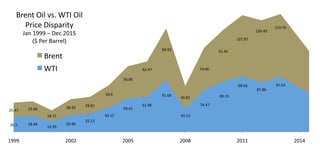
West Texas Intermediate (WTI) represents the price that U.S. oil producers receive and Brent represents the prices received internationally. The two prices have been diverting due to a recent surge in production in the United States that has caused a buildup of crude oil inventories at Cushing, Oklahoma, where WTI is stored and priced. Before this increase in U.S. oil production, the two crudes had historically traded in line with each other. 

Brent-WTI-Prices.jpgRealization of an oversupply issue put pressure on oil prices throughout 2014 & 2015. Crude oil production in the U.S. has surged because of the technology behind horizontal drilling and hydraulic fracturing, primarily in the states of North Dakota and Texas. Fracking makes it possible to extract oil and natural gas in places where conventional technologies are not effective. Fracking involves the use of high water pressure combined with sand and chemicals to create cracks in rock that allow the oil and natural gas it contains to escape and flow out of a well.

Both oil benchmarks have fallen substantially over the past two years. Brent lost 48% in 2014, followed by a 35% loss in 2015. WTI lost 46% in 2014, followed by a 30% loss in 2015.

Sources: IEA, EIA, Commerce Department

Remember:

"Truth will rise above falsehood as oil above water." - Meguel de Cervantes

Topics: Oil, oil exports

Savvy People Know What Raising the Fed Funds Rate Really Means

Posted by Wendell Brock, MBA, ChFC on Fri, Jan 15, 2016

What does it really mean when the Board of Governors of the Federal Reserve System, (“the Fed”, “the Federal Reserve Bank”) raises the Federal Funds Rate? Mortgage companies begin advertising that “rates are going up come see us now”! Well the Fed Funds Rate and Mortgage rates are not the same and really don’t have anything to do with each other – so what does happen when this rate goes up?

The actual rate that the Fed increased was the Federal Funds rate, from a range of 0.0% to .25% to a range of .25% to .50%. This the rate the Federal Reserve will pay banks that place “extra” or “idle” money on deposit at the Fed. The rate indirectly affects other borrowing rates set by large money center banks, such as the prime rate. Banks will deposit or loan money to the Fed if they don’t have places in the general public to lend money.Federal_Reserve_Bank_The_sea.jpg

Minutes following the Fed’s announcement, a major U.S. bank announced that it was raising its prime rate from 3.25% to 3.50%. Consequently, the Fed discount rate was also increased. This is the interest rate that the Fed charges banks as a direct loan, which increased to 1% from 0.75%.

In later disclosures by the Fed, the FOMC also voted to set a target for the Federal Funds rate of 1.375% at the end of 2016, implying four quarter point increases throughout 2016.

Should Fed officials continue on with their targets, economists and analysts expect a gradual rise in short-term rates over the course of the year. The Fed did state that loans linked to longer-term interest rates are unlikely to move very much during the same period.

The high-yield corporate bond market saw considerable turmoil throughout 2015 as energy sector debt weighed on the entire high-yield market. Even though only 15% of the high-yield market is made up of the dreaded energy sector, all other industry sectors were affected as well. Analysts believe that the sell off in high-yield debt now implies an expected default rate of 10%. That would be a sharp rise in defaults from the current 3% level should it come to fruition. Many believe that the odds of defaults rising to 10% are unrealistic and that the markets have already priced in worst case scenarios.

Some fixed income analysts have upbeat assessments for the bond markets in 2016. Assuming the U.S. economy continues to grow at a modest but steady pace, it will allow companies to expand and make it easier to repay bond debt. Improving consumer confidence and a low unemployment rate will help foster a healthy bond market.

Are you starting to see interest rates rise in your accounts? Perhaps the first rates to rise are of course the prime rate, then CD rates, and credit card rates, and maybe passbook savings accounts. Mortgage rates are based on long term bond rates that are sold on the secondary market, but that is a story for another day.

Onto a different topic: I want to thank you my readers, I am grateful for you following my blog and allowing me to be a part of your busy lives. I am truly grateful for your interest in financial topics – I really enjoy putting these articles together. So, Thank You and please feel free to subscribe your friends and family.

Sources: Bloomberg, Fed, Reuters

Remember: In honor of this weeks powerball. Classic response on establishing a lottery: they are "a tax on imbeciles." - Count Camillo Benso De Cavour, Italian Statesman, Diplomat 1810-1861


New Tax Rule Changes for 2016 – Plan NOW

Posted by Wendell Brock, MBA, ChFC on Thu, Jan 07, 2016

The New year is upon us now and there is much to do to get things rolling. One thing to consider is how you plan your taxes for this year. What you did in 2015 is over! Don't make the same mistakes. Here are the new numbers/limits issued by the IRS for 2016 they may affect your current situation. Plan this year to pay less!1040-tax-Form-Image-copy.jpg

Tax Day Is April 18th:

Emancipation Day is the day that Washington decided that taxes are due which traditionally has been April 15th. However under federal law, the tax deadline gets extended when it falls on a holiday or weekend, so the tax deadline for this year will be the following Monday, April 18th. States in New England that celebrate Patriots’ Day will have even a later filing deadline of April 19th.

Because this year is leap-year (29 days in February) and three extra days in April, taxes this year will be due a total of four days later than normal. WeeHa!

Most Tax Brackets Are Rising Slightly:

Based on an adjustment for inflation, 2016 will see most tax brackets rise by roughly 0.4%.

Head of Household Filers Will Get A Bigger Standard Deduction:

Taxpayers qualifying as head of household, will see their standard deduction rise $50 to $9,300.

Rise In the Earned Income Credits:

Families with three or more qualifying children will see their maximum earned income credit rise to $6269. Families with two children will be getting a maximum earned income credit of $5572, while families with one child will be able to get up to $3373 in earned income credit. Taxpayers with no children will be able to claim up to $506 in 2016.

HSA Contribution Limits Going Up:

Health savings accounts (HSAs) allow individuals with high deductible health plans to set aside money on a pretax basis in order to cover anticipated healthcare costs. For 2016 the contribution limits for individual policies will remain at $3350, however, the maximum contribution for family policies will rise to $6750. A catch up contribution of $1000 for those 55 or older will continue to apply.

Higher AMT Exemption Offers Some Reprieve:

Ever since its inception in 1969, AMT has been a fairly unpopular tax. It was initially intended to tax higher income individuals who may have been paying too little in taxes. However, since AMT was never properly adjusted for inflation, it now affects middle income taxpayers as well. A reprieve in 2016 with an increase in the exemption up to $53,900 for single tax payers, and a jump to $83,800 for joint filers.

Estate Tax Exemption Edges Up:

Since the lifetime exemption amount for the gift and state tax is tied to inflation, it is slated to rise slightly this next year for 2016, increasing the exemption amount to $5.45 million, applicable to those that pass in tax year 2016.

Affordable Care Act (ACA) Penalties On The Rise:

The affordable care act imposes penalties for those not having qualified healthcare coverage. For 2016, a penalty of $695 or 2.5% (whichever is higher) of income will apply to individuals not having any healthcare coverage. Families with no healthcare coverage will see a significant increase from a $975 maximum penalty to $2,085 maximum household penalty or 2.5% of household income (whichever is higher).

Dont get caught trying to plan your taxes in the month of December to maximize deductions and lower your taxes. Now is the time to start the plan and work the strategies throughout the year. Make it a successful 2016!

Sources: Tax Foundation, IRSClick to edit your new post...


Remember:

"How does what we know get in the way of what we don't know?" - Liz Wiseman

Topics: IRS, Income Taxes

One Trillion in Debt and Counting...

Posted by Wendell Brock, MBA, ChFC on Fri, Dec 18, 2015

A couple days ago the Federal REseve raised its short term rate 0.25 points, on that note we hope tha it has not spoiled your holidays! Americans seem to love debt, as many use debt for major purchases and economist use debt as economic indicators. While Americans are paying off their debt in one area they are increasing it so much in another area that economist are now following that debt much more closely…

Debt…

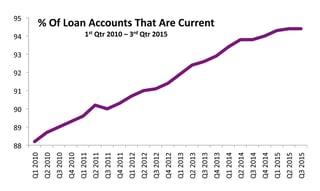
Following the financial crisis of 2008-2009, bank loans and financing became very challenging for U.S. consumers. As the job market has improved over the past few years, more Americans are working, thus allowing them the ability to pay down left over debt from the crisis.Current-Loan-Accounts.jpg

Demographically, most loans are taken out by younger consumers with growing families in the prime of their spending and borrowing years. Improving debt, characteristics of younger consumers, may also lend to better saving and investing behaviors as finances are managed better.

Delinquencies are a gauge of how well borrowers across the credit spectrum are able to repay their loans on a timely basis. Should delinquencies rise, it is an indicator of various factors, including weakening job market, lower wages, increased household expenses, and overextended consumers.

Over the past several months, delinquencies have dropped with an increased number of consumers paying their debt off on time. Such a pattern is an encouraging indication of improving consumer dynamics.

Auto Loans

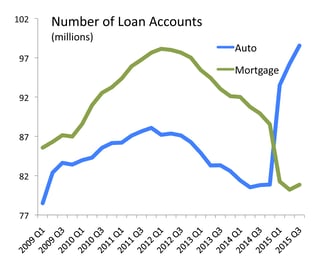
Rather than struggling to get approved for a new home loan or refinance, Americans are instead financing cars, where getting a loan approval is easier. The ability of fresh loans available to car buyers is also helping to elevate auto sales dramatically throughout the country.

This past quarter, auto loans, outstanding reached $1 trillion for the first time ever. The amount of total auto loans is rising faster than the amount of mortgage loans.

The average car loan is approximately $21,700, with the average monthly payment at $400. The average purchase price stands at about $32,529.Number-of-Loan-Accounts.jpg

As expensive as some automobiles have become for some people, an auto loan is the only method of actually affording the pricey cars of today. Over the years, several automobile companies have established their own financing thus allowing buyers to buy and borrow directly from them.

Economists have always placed a value on home mortgages, an indicator of economic growth, since homeowners must eventually furnish and maintain their valuable purchase. But now, the amount of auto loans being made is tracked by economists as yet another indication of consumer spending ability. An improving job market and stable wages have allowed consumers the ability of obtaining larger loans on more expensive cars.

Years ago I learned that most people (more than half) purchase a new car within six months after buying a house. I have watched many people do this over the years and then watched the struggles afterwards. Debt no matter the purpose is a cruel task-master. I encourage everyone to get out of debt, however fast you can, get out and stay out of debt.

I remember the old silly joke: if you are going to spend money on a car vs. a house spend it on the car, because you can always sleep in a car, but you can’t drive a house!

Source: Federal Reserve


REMEMBER:

The best pillow is a clear conscience. Merry Christmas

Topics: debt, auto loans

China Trades Places; Learn the Two Biggest Income Tax Problems Coming This Year

Posted by Wendell Brock, MBA, ChFC on Wed, Dec 09, 2015

Last week I talked about China and the placement of China’s Yuan in the IMF basket of currencies. This week China is back in the news with it becoming our largest trading partner. Additionally, my good friend Keith Earl, CPA offered a two major income tax issues that tax payers will face this coming year. It is best to get a handle on these issues before they become problems, costing time and money.

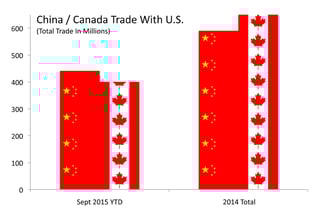
China surpassed Canada as America’s biggest trading partner this past quarter as reported by the U.S. Department ofChina-Canada-U.S.-Trade.jpg Commerce. Through September 2015, China had more import and export activity with the United States than Canada, the first time to ever occur. Total trade in 2014 with China and Canada was close, but now China has clearly eclipsed Canada as the primary trade partner with the U.S.

As America’s neighbor to the north, Canada and the U.S. share similar languages and customs, that have allowed for an ample trading relationship. The enactment of the North American Free Trade Agreement (NAFTA) in 1994 expanded America’s reach into Canada, as well as Canada’s into the U.S. Even with China’s distance and cultural differences, it has still been able to build and expand its trading relationship with the U.S. to new levels.

Imports from Canada into the U.S. include petroleum and automobiles, while the U.S. is a major exporter of grains and other food products to Canada. The U.S. is an exporter of food and capital products to China, with Chinese imports into the U.S. primarily led by computers and electronic devices. For more info on China's economic growth and the world market see this article: China, Currency and the World Market

From Keith…

I recently attended the tax update provided by my tax software company.  I learned a lot and wanted to share a couple of points to help each tax payer better prepare for the 2015 income tax filing season that begins shortly after the New Year. 

Identity Theft: We spent more time than ever before reviewing identity theft and the epidemic it has become related to income taxes.   Identity theft affected just about every tax practitioner office that attended the update. I had tax clients whose identity was compromised.  personal-income-tax-e1377245692746.jpg

There is an expanding identity theft industry mostly based overseas.  They acquire tax identification numbers from various sources and then prepare and electronically file income tax returns for these taxpayers, generating millions of dollars in refunds before the actual taxpayer is even ready to file their return.  

The IRS has made this one of its top priorities to stop this theft and to protect the American taxpayer.  Preparers like myself are doing all we can to prevent it too. In fact we are being tasked with the responsibility to maintain security of the data provided to us by our clients.  Our office is doing all we can to keep all data secure and confidential.   

There are some additional things that can be done for any taxpayer who wants to file a form with IRS to request that no electronic return can be filed using your social security number unless an IRS provided pin number is also used.  There are pros and cons for doing this.

The time to get this pin number is NOW before the tax season begins and identity thieves begin filing returns using your number.  

The conference discussion leader stated that it is not a question of whether your identity has been stolen.  The only question is how soon a thief will use that identity to create havoc in your life. 

The Affordable Care Act: The other topic of interest was the topic of the Affordable Care Act “Obamacare”.  Last year (2014) was the first year that reporting on tax returns regarding health insurance was required.  

There were many errors throughout the system in reporting health care information on 2014 income tax returns.  The instructor shared some statistics and some of the IRS enforcement activities that are associated with this new law and income tax filing requirement.  

Some taxpayers who obtained insurance from the online exchange got discounts on their insurance that should have been reported, but for which the taxpayers were unaware and did not correctly report.  Some taxpayers, especially senior taxpayers, may not have even filed a return because the only thing they needed to report was the healthcare subsidy they received.  And they had never had to file this in previous years.  This may be affecting you, your parents, or older relatives.  

If you have insurance from an exchange and got assistance with the premium, there is a good possibility that your insurance information was not 100% accurate on your tax return.  The IRS is matching tax returns with insurance policies and will advise insurance companies to take away the discounts that many citizens thought they had knowingly or not.  

The result is that some people on the insurance exchange may see their insurance rates go up in a huge way come January 1st. 

The people most likely to have this negative experience are senior citizens, such as your parents or grandparents, who got a subsidy, but maybe didn’t even file a return because their income was low enough that they would not have been required to file a tax return.  Because of the Affordable Care Act, they maybe were required to file a return just to report their insurance. 

If either of these issues are affecting you or someone you know, we are here to help in any way we can.

Sources: Dept. of Commerce, U.S. Census Bureau; Keith Earl, CPA


Remember:

Money flows from those who don't manage money to those who do. - Anonyms

Topics: Identity Thieft, China, Obamacare

China's Yuan Is Now In The IMF Basket

Posted by Wendell Brock, MBA, ChFC on Wed, Dec 02, 2015

When smaller, less developed countries from around the world need to exchange their currencies into a more utilized and liquid currency, they utilize SDRs (Special Drawing Rights), essentially a basket of currencies. Created by the IMF in 1969 to supplement a shortfall of preferred foreign exchange reserve assets, namely gold and the U.S. dollar, SDRs have evolved to over $200 billion in value.

The SDRs are currently made up of four currencies, the U.S. dollar, the euro, the yen, and the pound. Over the past few years, China has been aggressively bargaining to have its currency, the yuan, included in the SDRs. Such an inclusion is considered a validation by the IMF that a country’s currency is internationally recognized and accepted.

yuan-crop.jpg

In an effort to strengthen the world’s recognition of its currency, China has entered into currency swap agreements with other countries, bypassing the U.S. dollar as the reserve currency. Currently there are fourteen nations that have signed currency swap agreements with China allowing them to clear their trades using the yuan as the main currency. Those countries include: Argentina, Belarus, Brazil, Canada, ECB, Hong Kong, Iceland, Indonesia, Malaysia, Singapore, South Korea, Thailand, the United Kingdom, and Uzbekistan.

Monday, November 30th

The IMF announced that the Chinese yuan will be included in the SDRs basket of currencies. It is expected that the demand for the yuan will not increase much considering the currency controls of the Chinese government. Central banks have begun acquiring the yuan but they don’t expect to have a major increase in demand.

Central banks don’t use the SDR as a yardstick for determining the composition of their foreign-currency reserves. These are much more heavily influenced by cross-border trade, said Karthik Sankaran, a director of global strategy at Eurasia Group.

Before the currency swap agreements all trading with these countries and China were conducted with U.S. dollars as the reserve currency. While many policy makers don’t believe that the yuan will supplant the U.S. dollar anytime soon, no one thought the Chinese economy would grow to become as big as the U.S. economy anytime soon either.

The inclusion of the yuan in the SDRs Basket is a big deal to China, they view it as placing their currency value equal to that of the other currencies in the Basket. It’s a bit like letting the camel poke its head in the tent! Soon enough the entire camel is in the tent.

In our competitive world economy, China will continue to work at becoming the world’s largest economy and they will compete to become the world’s reserve currency. As the country with the largest population, they want to be a super-power on the world stage and set world economic standards. (Remember they are still a communist nation with limited human rights.)

With the fall of Bretton Woods system and increasing availability of credit through international banking institutions, SDR’s are not used as much as they were when they were first developed. After all we have left the gold standard back in the early 1970’s, which in essence changed precious metals (gold and silver) from a common median of exchange (controlled currency) to a commodity, greatly increasing their value and volatility, particularly as the currencies have been devalued over time.

What are your thoughts of this new development in the world’s economy?

Sources: IMF


Remember

"Peace and contentment come into our hearts when we save a portion of our earnings and avoid unnecessary debt."  - Ezra Taft Benson

Topics: Precious Metals, Yuan, SDRs, China, Currency

Who Should Have Long-Term Care Insurance?

Posted by Wendell Brock, MBA, ChFC on Wed, Nov 25, 2015

November as we know is the month in which we celebrate Thanksgiving, perhaps the most celebrated and gratefully under-commercialized holiday of the year, for which I am truly thankful. I love Thanksgiving – it is my favorite holiday. November is also Long-Term Care awareness month.

Long-Term Care is so very important to plan for. Throughout our lives we are bombarded with taking care of risks we are exposed to, auto accidents, home owners’ problems, life and disability, etc., but often we do not plan much for the end of our lives (actually few people die with a valid will in place). And what is left for our loved ones is literally a financial mess on top of the emotional challenges of losing a family member.Long-term_Care.jpg

Below is some information from two studies I would like to use, they lay out some statistics about Long-Term Care. The people who are prepared or ill-prepared for such a catastrophic problem might find the motivation to look for more information to help their unique situation.

According to researchers at Georgetown University and Pennsylvania State University, about 70% of individuals 65 and older will need some kind of long-term care—whether at home, in an assisted-living facility or nursing home.

But how many of them should purchase a long-term-care insurance policy? That number, it turns out, is far lower—at 19% of men and 31% of women, according to a new study published by Boston College’s Center for Retirement Research. (Women live longer on average, and so they’re statistically more likely to incur long-term-care costs; my own mother lived 27 years past my father.)

Surprise - most “individuals should not buy insurance,” wrote the authors of the paper, which was published in November 2014. However, this study only looks at strictly “nursing home care” and ignores assisted living facilities or home health care. Neither of these two levels of care are provided for by any government programs.

Most people do not need the coverage because they do not have a sufficient level of assets to protect. People work their whole lives to provide for themselves and their families, what is left over at the end they want to pass on to their heirs, Long-term Care insurance can help protect that final nest egg, so there is something left.  The value of owning a Long-term Care policy is related to the amount of assets one has and the estimated amount needed to cover the catastrophic cost of long-term care. Additionally the authors found, that for many people of modest means the coverage provided by of Medicare and Medicaid are adequate to cover most of their needs. 

To assess the odds of needing long-term-care, the researchers used government data to “calculate monthly probabilities of transitioning among various health states” from age 65 on. The “health states” are: “healthy, requiring home health care, living in an assisted living facility, living in a nursing home and deceased.” The data show that 44% of men and 58% of women will spend at least some time receiving nursing-home care.

However, many people spend only short spells in nursing homes. Government data show that, on average, men who require nursing-home care spend an average of less than a year in such care over their lifetimes. For women, the figure is about one year and four months.

As the study notes, “many short-duration stays in nursing homes are covered by Medicare,” which covers stays of 100 days or less following a hospital stay of more than 3 consecutive days, Half of all men and 40% of women who use nursing-home care fall within this coverage window, and Medicare picks up their tabs.

At the other end of the spectrum, Medicaid picks up the tab for extended stays in nursing homes for those who run out of money. There are also those people of modest means who try to game the system by spending their assets and thus causing self-inflicted poverty to qualify for Medicaid.

So who should consider buying coverage? According to Anthony Webb, a senior research economist at the Center for Retirement Research and a co-author of the paper, those with significant assets—of a couple hundred thousand dollars or more ($200,000)—should look into a policy. The target market, he adds, is “people who have a sizable amount of household financial assets and would be unlikely to qualify for Medicaid.”

Two things to remember: 1) The study primarily focused on nursing home care, and that type of care is far more comprehensive care than assisted living care and Home Health Care, both of which is covered with Long-Term Care, but not covered by Medicaid or Medicare. People tend to spend more time in assisted living facilities and using home health care then nursing home care. Nursing home care is truly an end of life type of care.

2) What triggers the receiving of long-term care benefits is the loss of two of six activities of daily living, which often allows a person to remain at home, but simply need help on a daily basis to tend to certain activities.

It is likely that in your adult stage of life, most people have experienced a friend or relative that has needed and or used, home health care, assisted living care, and/or nursing home care. There are many different types of policies to choose from. You will want a policy which is simple to understand and yet is flexible enough to cover your needs, while at the same time not being subject to massive rate increases. Or worse, a reduction of the benefits you have paid for, because you can’t afford the new rate increase.

My family has several times expressed gratitude for the policy my mother had, which kept her estate intact and left more to her heirs. It was a wonderful blessing for which I am truly grateful. But more than that it made it possible for my sisters, who were responsible for her, to be care managers rather than care givers – a significant difference between the two roles – and a major difference in the quality of life for both the care manager and the one receiving the care.

With that - I wish y'all a very happy Thanksgiving!


Remember

“When you walk with gratitude, you do not walk with arrogance and conceit and egotism, you walk with a spirit of thanksgiving that is becoming to you and will bless your lives.” - Gordon B. Hinckley


Topics: Long term care, LTC, Long term care insurance

529 Plans - An Estate Planning Tool

Posted by Wendell Brock, MBA, ChFC on Wed, Nov 11, 2015

Named after the IRS Code it falls under, Section 529 plans (529 Plans) have amassed over $244 billion in assets since their inception in 1997. Their popularity soared over the years as parents and grandparents realized their favorable tax benefits while also saving for college expenses. These 529 Plans are limited to only “higher education” or post high school education, where as a Coverdell Educational Savings Account can also be used for certain K-12 expenses.

529 Plans were initially intended to provide parents of young children the ability to save and invest money for future anticipated college related expenses, such as, tuition, books, room and board, lab fees, etc.


These plans offer two primary benefits: assets grow tax deferred and come out tax free for qualified expenses; and, contributions made by parents and grandparents are considered a gift, thus proving a tax benefit for some contributors.

Over the years, both wealthy and lower-income parents and grandparents have been the main contributors to these plans. The maximum contribution in to any one plan in Texas is $370,000, this can be made in one payment or through monthly or annual contributions.

Any parent or grandparent can make gifts of up to $14,000 per year per individual person (child) and to as many individuals as they wish. 529 Plans allow gifts to be made five years ahead all at once. Thus, a grandparent can gift $70,000 per grandchild at once for the next five years. If the grandparent has five grandchildren, then they have the ability to contribute $350,000 at once to the 529 Plans, which are considered gifts. There would be no gift tax, assuming no other gifts were made to that child over those years.

Another benefit of 529 Plan is the ability to change beneficiary to another member of the beneficiary’s family. This flexibility allows the family to set up one account for several children as the balance can roll down to the youngest child without any penalties.

Such generous contributions allow a reduction in the contributor’s taxable estate. This is an ideal strategy for parents and grandparents that may have estates valued at over $5.43 million, the current federal estate tax exemption level. The federal estate tax exemption, that’s the amount an individual can leave to heirs without having to pay federal estate tax, is $5.43 million for 2015.

While many people are not in the above situation of needing to reduce their estate size to avoid paying estate taxes; using such a gifting strategy may be advantageous for other family reasons. With the high cost of a college education any help from family should be appreciated by the student.

Selecting the right strategy for college savings or combination of strategies is worth the time and effort. A discussion with your financial advisor of the different strategies and what would make the most sense for your family should be part of the plan, after all next to you no one should know your finances better and how best to integrate the strategies.

 For More Info on College Savings

Source: IRS, Saving For College

Remember

Remember the only real control is self control. - Jefrey R. Holland

Topics: College Savings, Section 529 Plans, Estate Planning, Coverdell Education Savings Account

120514_WWBrock_1

Wendell W. Brock, MBA, ChFC

Subscribe by Email

Follow Me

Most Popular Posts

Other Sites I Follow, hobbies, fun and info:

gold-vs-silver-1.jpg  Nauvoo Mint brokerage services for precious metals


john Mauldin chair

Note:

Outside Economics is not a registered investment advisory firm (RIA) and does not act as an RIA. Outside Economics does not provide any specific investment advice. Any information obtained from this website or through one of  Outside Economics' representatives should be reviewed by a professional.

Subscribers Note: We do not sell our email list. Period. Thank you for subscribing.

Recent Posts