Outside Economics

Disability Insurance

Posted by Wendell Brock, MBA, ChFC on Wed, May 14, 2014

There are a few types of insurance coverage that are essential to have in this day and age. Disability insurance is one of those. If you die, your life insurance will take care of your family; but if you get hurt and become disabled, then what? The average monthly benefit from Social Security disability is $1,004 a month. Will that be enough to take care of your current needs?DDApic

Many people live such active lifestyles that the risks of a serious injury is very real. We all know someone who has been injured playing one sport or another, an auto accident, or simply injured falling off a ladder trimming the tree! It happens all the time – that is why we have Emergency Rooms at the hospitals!

Disability insurance helps protect a portion of your income and provides financial protection if you become disabled for an extended period of time. If you are permanently disabled, not only will you be unable to work, but you may also need financial resources to be cared for. Anyone who depends on their income to pay the bills or maintain their lifestyle should consider disability insurance protection.

Many companies offer great rates on disability insurance to their employees. You can also shop around for private insurance companies to find out their rates and policies. Make sure 65-70% of your current income is covered for an extended time period, usually until death or age 65.

A simple rule of thumb is the M.U.G.® Plan = Mortgage, Utilities, & Groceries. Do you have enough disability insurance to cover these three very important expenses? Think of it this way, which job would you prefer:

Monthly Income Job A Job B
While Working $6,000 $5,900
If Disabled $0 $4,000

There are some key features of disability insurance that are important to be aware of. A disability insurance policy can complement existing disability benefit coverage that may be available to you. A disability insurance policy is fully portable; you own the policy and so you can take it with you throughout your career. There are policies that offer flexible solutions for various income levels. Also, depending on how the policy is set up, the benefits may or may not be tax-free.

Determining whether your benefits are taxable depends on a few factors. These factors include what type of benefits you receive, whether the premiums were paid with pretax or after-tax dollars, and who paid the premiums (you or your employer).

The rules surrounding taxation of individual disability income insurance benefits are generally simple. When you pay the premiums with after-tax dollars, the benefits you receive are tax free. When you pay your premiums with pre-tax dollars, your benefits will be taxed. This rule of thumb is the case whether you are enrolled in a group plan, a cafeteria plan or a medical reimbursement plan. However, unlike health insurance premiums, you can't deduct premiums paid for disability insurance as a medical expense.

If you are enrolled in a group disability insurance plan sponsored by your employer, the tax-ability of your benefits depends on who pays the premium. If you pay the total premium using after-tax income, then your benefits will be tax free. On the other hand, if your employer pays the total premium and does not include the cost of coverage in your gross income, then your benefits will be taxable. If your premiums are split by you and your employer, then your tax liability will be split as well.

It comes down to this: If you never use your disability benefits, you'll save money by paying your premiums with pretax dollars. But if you do use your disability benefits, using after-tax dollars to pay your premiums places you in a better position.

Different rules apply to an employer who pays for a disability insurance policy on an employee. This may be the case if there is a key employee in the business. If the employer gets the benefit, then the premium is not deductible to the company, and the benefit is not taxable when received by the company.

All, part, or none of the disability benefits you receive through government disability insurance programs may be taxable. How much of the benefit is taxable and under what circumstances depends on the type of government disability benefit you are receiving. These government benefits include Social Security disability income, Medicare benefits, worker's compensation, veteran's benefits, military benefits, and Federal employee's retirement system benefits.

A lot relies on your income, perhaps even more than you think. If the unexpected happens – if you become too sick or hurt to work – would your savings or the disability benefits you receive through your employer be adequate?  As always, consult a trusted professional for advice.

I know what your saying, "It will never happen to me!" Right?

Topics: life insurance, Social Security, Medicare, Disability Insurance

Private Banking and Insurance

Posted by Wendell Brock on Wed, May 07, 2014

Most people have never thought that they could become their own “private bank” or that acting as your own personal lender was an option; but with the private banking concept, you are able to make this a possibility and have the opportunity for more financial freedom. This concept borrows the term “private banking” from the banking industry simply because of the similarities of creating a pool of money that you privately control that can be loaned out as needed. Having this money available allows you to remove the traditional bank from the equation and essentially you become your own personal bank.

Nothing else2 E

There are many benefits to setting up your own private bank. Private banking has over 200 years of history. It is successful in part, because it has endured over a dozen recessions and the great depression.

A private bank is protected from investment losses as well as from taxes. It grows tax-free, you can use it tax-free and you can retire on the funds tax-free. Because your own private bank is set up through a whole life insurance policy, the IRS considers the dividends earned a return of the policyholder’s premium, thus allowing the dividend to remain a tax-free benefit of the policy.

The cash build up may be taxable if used and then the policy is canceled; any gains above the premium deposits would then be taxable as long term capital gains.

Typically there are no limitations on how much you can put in, or when you have to take it out. The policies on the whole demonstrate a consistent growth between 3.5 to 7.0 percent. While volatility abounds everywhere, this remains the most consistent, predictable place for growth. It’s your money, use it when and how you want to. 

As was mentioned above, the primary vehicle by which an individual can participate in this concept of private banking is through the use of a whole life insurance policy, which acts as the individual’s lending vehicle. The whole life insurance policy becomes your bank. Whenever you need to make a large purchase, you borrow money out of the policy like you would a bank. However unlike traditional financing, you are earning the interest, rather than the bank.

For those who would argue to simply save up the money in a savings account, this notion of earning interest is the crucial detail that gives private banking a huge advantage. When you take the money out of savings, you don't make anything on the money you pulled out. The bank stops paying interest when the money leaves the account. When you take a loan from your own private bank, you still earn interest and dividends on the money as if you never took out the loan. 

Another one of the great benefits of having a private bank through life insurance is the level of additional asset protection that it provides its clients and their beneficiaries. This type of policy set-up has protected the assets of many people from frivolous law suits, bankruptcy or other creditor problems that may arise in our litigious society. In short, the values of life insurance – both the cash value and the death benefit – are protected from creditors under specific conditions. It’s important to note that the level of protection varies in every state so it warrants your further research on this subject.

In a nutshell, with these contracts, you build up tax-free capital for all of your own borrowing and financial needs; and, as a nice bonus, your family (or estate) can receive a substantial built in tax-free inheritance (death benefit), should you die; and you could receive a large, tax-free retirement income, should you live. In part, it all depends on how well you decide to fund, or over-fund, your own bank.

It is very important to understand and to appreciate that these unique policies are not the typical whole life policies sold by many life insurance agents. Instead, these policies are individually created for each person's own financial circumstances. These policies are specifically designed only by mutual life companies – not stock life insurance companies. There are only about a few dozen or less of these companies left in the United States.

As always, it is in your best interest to consult a trusted financial adviser before setting up your own private banking policy. Be aware of their credentials and make sure they know the ins and outs of creating such an individualized policy for you. This concept may not be for everyone, so be sure to study it out and decide if it is right for you.

Topics: tax free, Private Bank, Whole Life Insurance

Alternative Investments

Posted by Wendell Brock, MBA, ChFC on Thu, May 01, 2014

With bonds yielding almost nothing and stocks looking fully valued by most measures, investors need more choices. Fortunately, they’re out there. For decades, the biggest institutional investors have used alternative investment strategies to generate higher returns, with less risk, than standard portfolios.  Today, most of these strategies and asset types are available to Main Street, often through ETF’s or mutual funds or similar investor-friendly formats. But, like any investment, you need to inform yourself.alternative assets

Master Limited Partnerships

MLPs (master limited partnerships) are a type of limited partnership that is publicly traded. There are two types of partners in this type of partnership: The limited partner is the person or group that provides the capital to the MLP and receives periodic income distributions from the MLP's cash flow, whereas the general partner is the party responsible for managing the MLP's affairs and receives compensation that is linked to the performance of the venture.

One of the most crucial criteria that must be met in order for a partnership to be legally classified as an MLP is that the partnership must derive most (~90%) of its cash flows from real estate, natural resources and commodities.  Congress established these special vehicles in the '80s to spur investment in energy infrastructure, and that’s just what this rapidly expanding industry needs today: money for drills, pipelines, and storage, etc. The advantage of an MLP is that it combines the tax benefits of a limited partnership (the partnership does not pay taxes on the profits - the money is only taxed when unit-holders receive distributions) with the liquidity of a publicly traded company.

Long/Short Funds

Long/short funds are the mutual fund industry's attempt to bring some of the advantages of a hedge fund to the common investor. Most long/short funds feature higher liquidity than hedge funds, no lock-in period and lower fees. However, they still have higher fees and less liquidity than most mutual funds. Unlike most mutual funds, long/short funds often require a minimum investment of more than $1,000.

Long/short funds aren't allowed to use as many derivative and short positions nor as much leverage as hedge funds, but they do provide some diversification to the average investor in down markets. Today, several high-quality mutual funds offer access to this strategy but still provide all the usual mutual fund benefits, including daily valuation and liquidity. While these funds won’t keep up with the market during big bull runs, they should significantly outperform it on the downside.

Private Equity

Private equity has been the top performing asset class for big investors for a long time, but it has been a tough area for regular investors to participate in. That’s changing. Private equity consists of investors and funds that make investments directly into private companies or conduct buyouts of public companies that result in a de-listing of a publicly traded entity. Capital for private equity is raised from retail and institutional investors, and can be used to fund new technologies, expand working capital within an owned company, make acquisitions, or to strengthen a balance sheet.

The majority of private equity consists of institutional investors and accredited investors who can commit large sums of money for long periods of time. Private equity investments often demand long holding periods to allow for a turnaround of a distressed company or a liquidity event such as an IPO or sale to a public company.

Collectibles

Most collectible assets classes -- memorabilia, jewelry, cars -- should be looked at as hobbies with an upside. These can be fun to get into, but they’re really not suitable for people just looking for returns. This type of investing requires an extremely deep understanding of the particular collectible, the market and the capital. This can be a very illiquid area of investing. I knew a fellow early in my career, who had an amazing collection of over 500 Lugar Pistols, many had been owned by famous people, but he couldn’t sell the collection. A nearly $500,000 investment with no way to convert it to cash.

Art may be an exception. Art has been recognized as a store of value for centuries in almost every civilization, and there are several high quality funds that specialize in this (some even lend out its art to its investors). The trick is to invest behind someone who is both a true expert and an experienced, trusted fiduciary.

Angel Investing

An angel investor or angel (also known as a business angel or informal investor) is an affluent individual who provides capital for a business start-up, usually in exchange for convertible debt or ownership equity. A small but increasing number of angel investors organize themselves into angel groups or angel networks to share research and pool their investment capital, as well as to provide advice to their portfolio companies.

Angel investing is exciting but risky. Most angel investors will tell you they expect a return ratio of one third, one third, one third. One third of his/her investments make money, one third go bust, one third plod along. But stats indicate that serious angels can achieve internal rate of return of well over 20%, which is obviously very attractive. Probably the best way into the field for new investors is to join a professional angel group.  To find a group to join, you can go through the Angel Capital Association.

If you’re going it alone, make sure a start-up can clearly explain the problem they’re solving, the solution they propose, why their team can handle it, the size of the market, and what the competition looks like. Two more tips: the first money into a start-up should be from a small “friends and family” round (not from you!). And the second is to be sure to keep more money ready for the next round, because the start-up will need it and you may want to invest more.

Arrow Choices MI resize 600x338

Like any investment, it is important that you know exactly what you are getting involved in and it is critical to clearly understand the exit strategy – how do you get out of the investment? Or how do you cash out? This and the time commitment arvery important, are you committing your money for 3 years, 5 years, or 10 years, the longer the commitment period the greater the return should be. You will want to counsel with an experienced financial consultant who is experienced in the type of investment you are pursuing.

Topics: Bonds, Master Limited Partnerships, MLP's, Collectibles, Angel Investors, Private Equity, Stocks, Institutional Investors, MLPs

Medicare Basics

Posted by Wendell Brock, MBA, ChFC on Wed, Apr 23, 2014

Medicare is health insurance for Americans 65 and older, those younger than 65 with certain disabilities, and people of any age with End Stage Renal Disease (ESRD). The federal government administers Medicare, and you apply for it through the Social Security20071227 medicare 18 Administration (SSA). There are several types of Medicare coverage.

  • Original Medicare, or Parts A and B, cover inpatient care (Part A) and outpatient services (Part B).
  • A Medicare Advantage plan, called Part C, is sponsored by a private company. Medicare Advantage plans sometimes offer additional services not covered under Original Medicare. Some Medicare Advantage plans also provide prescription drug coverage. You must have enrolled in Parts A and B to enroll in Part C.
  • Medicare prescription drug coverage is called Part D. Like Part C, Part D is provided by private companies.
  • Medigap plans are forms of supplemental insurance that pay for costs not covered by Original Medicare. If you have a Medicare Advantage plan, you cannot also have a Medigap plan.

The advantage plans or Part C, and Part D are likely to become more important than ever. With the baby boomers retiring in massive amounts the Medicare System will be stretched very thin. This will cause two things, 1) an increase in taxes and premiums to pay for the coverage, and 2) a continued reduction of benefits paid for by Medicare.

There are different time periods during which you can enroll in Medicare. For many people, the Initial Enrollment Period - a seven-month period around your 65th birthday - is common. There are also Special Enrollment Periods for people who are retiring and losing employer health coverage, or whose spouse who carried coverage is retiring.

You will want to learn about the different times you can enroll, and which time applies best to your situation. If you don’t enroll on time, you could be without coverage for up to four months and you may have to pay a penalty that lasts as long as you have Medicare!

Timing is also important if you decide to purchase supplemental insurance. You should sign up for supplemental insurance within six months of when you sign up for Part B. If you wait too long, the insurance company can deny you coverage, or charge you higher premiums for pre-existing conditions and impose a waiting period before your coverage starts.

Many people continue to work past age 65, and have health coverage through their employers. Others may be retired, and have insurance through the military (VA or TRICARE benefits) or employee unions. There are different rules depending on whether you are “actively employed” or retired.

Be sure to contact the benefits administrator of your current plan to ask about how it works with Medicare, and if and when you need to sign up for Medicare. You may also want to call the Social Security Administration to make sure that your employer’s advice is consistent with SSA policies.

It is recommended that you seek advice well in advance of signing up for Medicare. Find a trusted insurance source that is well trained in the ins and outs of Medicare. Do your own research as well. Knowing when to sign up and what to sign up for can save you headaches and hassles down the road!

One headache is finding the right doctor, prior to signing up you will want to find out if your current doctor accepts Medicare. If not you will have to go Medicare doctor hunting, which is about the same thing as hunting elephants in Alaska! Fewer and fewer doctors are accepting Medicare – I was visiting with one Doctor who had to stop because his office overhead (staff, rent, utilities, supplies, etc.) was higher than what he was being reimbursed by the government. What has been your experience with Medicare? Good? Bad? Or indifferent? 

Topics: Medicare, Baby Boomers, Social Security Administration

Yuck - Life Insurance!

Posted by Wendell Brock, MBA, ChFC on Thu, Apr 17, 2014

about life insuranceThere are two things in life that are inevitable: death and taxes, as the old saying goes. This article will discuss ways in which you can protect your family upon your death with life insurance – there it’s been said; no one likes to talk about life insurance! While this may not be a very uplifting topic for most people, it is better to plan and be prepared for the event now, than to put it off and perhaps leave your family coping with both your loss and a personal financial crisis.



If you have young children at home, this is an especially important topic. It doesn't matter if you are a breadwinner or a stay-at-home parent. Having adequate life insurance coverage for both spouses will ensure that your family will be provided for once you are gone.

A good rule of thumb is to have ten to as much as twenty times your income in life insurance coverage.  If you are in debt, this amount should cover any remaining debt, burial costs and leave money enough to invest, whereby earning a rate of return that replaces your lost earnings.

If you have a small policy through your employer, that may not be enough. A small policy may be able to cover burial expenses and living expenses for about a year, but what will your family do after that? You may need to review it and consider purchasing a separate policy. Making sure you have plenty of coverage will allow your family to live comfortably until they figure out the next step in their lives.

Waiting too long to buy life insurance is risky for a few reasons. First, it is always possible that something may happen to you before you are able to buy a policy and your family is then left unprotected. You may have a change in health that could substantially increase your rates or even eliminate your ability to have life insurance. Also, life insurance is cheaper to purchase when you are younger and the rates are locked for the set time of the policy.

In considering the term length of the policy, don't try and save money by purchasing a shorter term. A lot of health changes can happen in a small amount of time and you could be hampering your future ability to have inexpensive coverage. As a general rule, if you are planning on having children in the future, having a 30-year or longer plan might make sense for you. If you have young children but are not planning on having any more, than a 20-year policy might be appropriate.

You may have needs that truly last a lifetime and would require a mix of term insurance and permanent insurance. That is a challenge is to properly asses a family’s needs and plan accordingly. Even though some needs may change over time, some financial needs are constant or some needs are replaced by other needs.

Insurance premiums are based on three general areas: the insurance company administrative expenses, company investment returns, and mortality expenses (death claims paid). Term rates are generally lower due to the fact that so many of the policies expire before the company pays a death claim. Fewer claims, lower premiums. Permanent insurance or cash value policies are typically in-force for a longer period of time and thus experience more death claims and thus have higher initial premiums. Even with term insurance, a 30 year term policy will be much more expensive than a 20 or 10 year term policy – the risk of death and thus the risk of paying a death claim is greater for the insurance company – so the premium expense is much higher.

It is good to review your policy from time to time to make sure your coverage is adequate to your needs. Circumstances and needs change as life progresses and you may find that the policy you purchased 10-15 years ago will no longer do for your family. Perhaps you are making more money now and your family is used to a higher lifestyle. Or maybe your health habits have improved and you can qualify for better premiums. Periodically assessing your circumstances can either help you save money or require additional coverage.

Be sure to shop around before you purchase your insurance. At times the cheaper policies have the most stringent underwriting standards, thus making the slightest health problem(s) a standard rate instead of the advertised preferred rate. Independent agents can pull quotes from many different sources, thus ensuring a competitive quote. Educate yourself before purchasing any policy.

Life insurance is a major part of a wise financial plan. Love your family enough to protect them from a financial crisis in the midst of their grief. Remember the insurance is not for you – its for the people you love most! Is your family properly protected?

Topics: life insurance, death, taxes, permanent insurance, term insurance, cash value, personal financial crisis, debt

Long-term Care Insurance

Posted by Wendell Brock, MBA, ChFC on Thu, Apr 03, 2014

Nearly everyone knows someone over age 50, the prime age to purchase Long-term care insurance (LTC), which is an insurance product that helps provide peace of mind and dignity for the elderly who need assistance caring for themselves beyond a predetermined period. There are many aspects to this insurance, how premiums are priced, when does a person go on claim, how many people need the care, etc. Below these items and many more will be discussed.long term care insurance

Long-term care insurance covers care generally not covered by health insurance, Medicare, or Medicaid. Individuals who require long-term care are generally not sick in the traditional sense, but instead, are unable to perform some or all of the basic activities of daily living such as dressing, bathing, eating, toileting, continence, getting in and out of a bed or chair, and walking.

Age is not a determining factor in needing long-term care. According to the U.S. Dept of Health and Human Services, about 60 percent of individuals over age 65 will require at least some type of long-term care services during their lifetime. About 40% of those receiving long-term care today are between 18 and 64. Once a change of health occurs long-term care insurance may not be available. Early onset (before age 65) Alzheimer's and Parkinson's Disease are rare but do occur.

LTC insurance generally covers home care, assisted living, adult daycare, respite care, hospice care, nursing home and Alzheimer's facilities. If home care coverage is purchased, long-term care insurance can pay for care within your own home, often from the first day it is needed. It will pay for a visiting or live-in caregiver, companion, housekeeper, therapist or private duty nurse up to seven days a week, 24 hours a day (up to the policy benefit maximum).

Other benefits of long-term care insurance:

  • Many individuals may feel uncomfortable relying on their children or family members for support, and find that long-term care insurance could help cover out-of-pocket expenses. Without long-term care insurance, the cost of providing these services may quickly deplete the savings of the individual and/or their family.
  • Premiums paid on long-term care insurance may be eligible for an income tax deduction. The amount of the deduction depends on the age of the covered person. Benefits paid from a long-term care contract are generally excluded from income.
  • Business deductions of premiums are determined by the type of business. Generally corporations paying premiums for an employee are 100% deductible if not included in employee's taxable income.
  • Medicaid provides some of the benefits of long-term care insurance. As a welfare program, Medicaid does provide medically necessary services for people with limited resources who need nursing home care but can stay at home with special community care services. However, Medicaid generally does not cover long-term care provided in a home setting or for assisted living.

Once a person purchases a policy, the language cannot be changed by the insurance company, and the policy usually is guaranteed renewable for life. It can never be canceled by the insurance company for health reasons, but can be canceled for non-payment.

LTC insurance rates are determined by six main factors: the person's age, the daily (or monthly) benefit, how long the benefits pay, the elimination period, inflation protection, and the health rating (preferred, standard, sub-standard).

Most companies will offer couples and multi-life discounts on individual policies. Some companies define “couples” not only to spouses, but also to two people who meet criteria for living together in a committed relationship and sharing basic living expenses.

Most companies offer multiple premium payment modes: annual, semi-annual, quarterly, and monthly. Companies may add a percentage for more frequent payment than annual. Options such as spousal survivorship, non-forfeiture, restoration of benefits and return of premium are available with most plans.

You should not purchase any long term care insurance if you currently receive or may soon receive Medicaid benefits, if you have limited assets and can’t afford the premiums over the lifetime of your policy, or if your only source of income is a social security benefit or supplemental security income. Insurance companies and the National Association of Insurance Commissioners advise that you should not spend more than 7% of your income on this insurance.

The LTC industry suggests that you’ll pay less if you buy your policy at age 50 instead of waiting until age 60 as others recommend. Many people worry that if they wait until age 60 to buy LTC, they will develop a medical condition that will either prevent them from qualifying for coverage or significantly raise their premiums. The average age of purchasers has dropped from 68 years in 1990 to 61 years in 2005, and the number of purchasers who are under age 65 has increased significantly.

ltc solutions

Some may argue waiting until age 60 because you are much less likely to file a claim before that age. Statistically, 90% of LTC claims are filed for people over age 70. But if you have a family history of illness at a young age, or you are losing sleep because you’re worried about getting sick and not being able to afford care, then buy LTC when you can afford it. The peace of mind is worth more than any cash you’ll save on premiums.

Many people think that they will use a retirement account to help fund Long-term Care, should you need it. Remember withdrawals from retirement accounts are subject to income tax. However if this is done right the withdrawals for Long-term Care maybe income tax free, saving retirees thousands of tax dollars.

While there are hundreds of thousands of these policies that have been issued, still 93% of retired Americans, who are the very people who need this coverage don’t have it. It has been said that your retirement plan is not complete without long-term care insurance in place.  Have you looked into LTC insurance for yourself or your parent(s)?

Topics: retirement, LTC, LTC insurance, Long-term Insurance, elderly, Insurance, retirees, tax free

The Envelope System

Posted by Wendell Brock, MBA, ChFC on Wed, Mar 26, 2014

If you have been working at living within your budget but struggle at times, here is an idea that you may consider implementing: the Envelope System.

Using the Envelope System can be a great support to ensure that the budget is being followed. This system, as it's name implies, uses envelopes labeled with different budget items that can be paid in cash. Basic categories may include groceries, eating out, clothing, and miscellaneous expenses.

Envelope System images

Each time you get paid, cash out the amount of money that you would need to fund each envelope. With the cash in hand, you then divide it into the envelopes named for the different categories. Once the cash is gone, then you know it is time to stop spending.

If you find yourself constantly needing to adjust a category throughout the month – or robbing other envelopes to make purchases, then you may need to rethink the allotted amount for that category. This is particularly true with the grocery budget. It is often wise to over-fund this category.Be careful not to rob the other envelopes when one envelope is empty. A common occurrence is to rob, say, the clothing envelope, after the grocery money is spent. That's fine if you do – things happen! But keep in mind, no new clothes until the clothing envelope is funded again!

This method also works well for things that are not normal monthly expenses. A Christmas envelope that is funded each month can take a lot of stress out of the holiday season. A vacation envelope can ensure that the family trip actually happens this year! These may actually be best done with separate savings accounts at the bank.

Other random envelope categories may include birthdays, house repairs, concerts or entertainment, sporting events, garden or yard care expenses, car repairs, or any hobbies you may have. They may even include saving for special goals, perhaps a new car, jewelry, or season tickets to your favorite sports team!

Another tip on using the Envelope System, is that you can write a date and amount on the envelope each time you remove money; this will help you keep track of the money spent. This is helpful because cash has a way of disappearing – not necessarily by the common thief – by simply spending too much too fast.

This is an easy way to put a check on your spending habits as well as a way to ensure that your goals and dreams come to life! As with budgeting this will take discipline to implement. 

Topics: Budget, Envelope System, savings account

Budgeting 101

Posted by Wendell Brock, MBA, ChFC on Wed, Mar 19, 2014

Many people squirm at the thought of actually budgeting their money. Some say it constricts their money and makes them feel like they have less. For people who actually make and use a budget, they know otherwise; a budget simply tells their money where to go. People who live on a budget know the benefits of living intentionally with their money.budgeting piggy bank

When considering a budget, it is important to know three things: how much money is coming in; how much money is going out; and where is the money going. Unless you are living on an irregular income- say a commission based income - money coming in may be the easier of the three to figure out.

Once that is established, it is time to start figuring out the bills and the random spending that may be a little out of hand. Where does it all go?

Begin by making a list of all the bills and recording the amounts due each month. It may be good to see if any of these bills are higher than what they ought or could be. For example, housing expenses should fall between 25-33% of income. Any more than that and you will find yourself stretched too tight and will struggle to make the rest of your monthly payments.

            Here are some general guidelines to follow when constructing a budget:

            Housing: 25-33%                    Charity: 10-15%

            Utilities: 5-7%                       Clothing: 2%

            Food: 5-10%                          Saving: 5-10%

            Transportation: 10%               Personal: 5%

            Medical: 5-7%                        Recreation: 5%

            Miscellaneous: 5%

Keeping track of your spending can be a real challenge! There are a number of online tools you may find to be of help. One online web site is called mint.com. Some banks also offer online tools to help track your spending.  Debt management can be a very challenging part of the budgeting process for most people; it will be discussed in another article.

It is important to spend every dime on paper before the month begins. Decide at the beginning of the month what is important to you. If you have a savings goal, or a charity goal, or if you know that a trip is coming up, allocating those funds at the beginning of the month is essential so that these goals are met.

You may find yourself constantly adjusting your budget as the month goes on. It may be that you didn't set aside enough money to certain categories. For example, you may need to over-fund your grocery category in order to keep within your budget. It may take you a few months to get the numbers adjusted to fit your needs, so don't become discouraged. As time goes on, you will get a better feel for how much is needed in each budget category.

As a married couple, it is vital that each spouse come together each month to work out the budget. Both spouses should have a say in where the money goes even though only one spouse is likely to be doing the manual labor part of the budget. Working together here will benefit the marriage as a whole because money is a reflection of our goals and dreams.

For those of you who are single and considering marriage, talking to your dates about finances is an essential way to get to know each other. Keep in mind that the size of the paycheck isn't what matters most, but what happens with that paycheck that can be a deal breaker. If you are dating someone who is heavily in debt and perhaps is a chronic spender, you will need to heavily consider the consequences of attaching yourself to them.

If finances were only about math, then few of us would have financial problems. Search out your triggers, be aware of your habits, and mend them if they need mending. Recognize that our emotions play a big role in our abilities to have and follow a budget.

Keep working at it and know that everything becomes easier with practice.   Living on a budget is an essential step towards financial freedom! Good luck as you embark on this exciting journey!

Topics: Budget, Spending Plan, budgeting

Qualifying with the New Mortgage Laws and the Housing Recovery

Posted by Wendell Brock, MBA, ChFC on Fri, Feb 21, 2014

Since the housing bubble popped five years ago, mortgage lenders have been reluctant to lend. The banks held on through the devastating loses and are now cautiously finding themselves in a position to begin lending again. One of the reasons for banks being so cautious in mortgage lending now is that Freddie Mac, Fannie Mae and the FHA have been pressing lenders to buy back home loans that went bad after the crisis.Mortgage Approved

Another reason lenders remain cautious is in part because of financial reform rules. Under the 2010 Dodd-Frank law, mortgage borrowers must meet eight strict criteria including earning enough income and having relatively low debt. If the borrower doesn't meet those hurdles and later defaults on a mortgage, he or she can sue the lender and argue the loan should never have been made in the first place.

Those kinds of rules have helped build a wall between prime and subprime borrowers. Lenders have been soliciting consumers who are legally easier to serve, and avoiding those with weaker credit scores and other problems. Subprime borrowers accounted for 0.3 percent of new home loans in October, compared with an average of 29 percent for the 12 months ended February 2004, according to Mark Fleming, the chief economist of CoreLogic (CLGX).

As part of these rules, the lender must collect and verify a borrower's financial information. The lender has to check the information using reliable documents, such as a W-2 or a paystub. The lender generally must consider eight types of information:           

1. Current income or assets.

2. Current employment status.

3. Credit history.

4. The monthly payment for the mortgage.

5. Monthly payments on other mortgage loans borrowers get at the same time on the same property.

6. Monthly payments for other mortgage-related expenses (such as property taxes)

7. Other debts.

8. Monthly debt payments, including the mortgage, compared to monthly income (“debt-to-income ratio” which cannot be more than 43% or $43 for every $100.) The lender may also look at how much money is left over each month after paying debts.

Thanks to the Consumer Financial Protection Bureau, some other new rules that became effective in January include:

Restrictions on dual tracking. In the past, borrowers dealing with mortgage troubles sometimes found that their mortgage servicer had moved forward to foreclose on their home at the very same time it was working with them on a potential loan modification. That’s called “dual tracking” and the new rules set up clear guidelines that restrict this practice.

More help for troubled borrowers. Too often borrowers have had to apply over and over again for programs that might help them keep their homes, being asked to send in the same paperwork repeatedly. The new rules require mortgage servicers to evaluate a borrower who files a complete application for help for all the options that are available to that borrower. That means no more multiple rounds of applications and wasting of precious time and resources for the homeowner seeking help!

No more runarounds and missing documents. The rules require mortgage servicers to train their people to answer borrower's questions and, if the borrower does run into trouble, the servicer has to assign people to help them. The servicer also has to have policies in place to make sure they don’t lose their paperwork.

As mortgage revenue continues to decline, lenders such as Wells Fargo are now even considering borrowers with credit scores as low as 600 - in the past, 640 was the lowest they would consider. Lenders have plenty of incentive for reaching lower on the credit spectrum now; since the middle of last year, interest rates for mortgages have been rising and are expected to reduce the total U.S. Mortgage lending for 2014 by 36%- down to $1.12 trillion. According to the Mortgage Bankers Association, this is due to a large drop in refinancing.

A recent report from the Urban Institute and Moody's Analytics argued that a full recovery in the housing market "will only happen if there is stronger demand from first-time homebuyers. And we will not see the demand needed among this group if access to mortgage credit remains as tight as it is today."

To be sure, credit is still only trickling down to subprime borrowers. Jamie Dimon, chief executive of the second-largest U.S. mortgage lender JPMorgan Chase, said on a conference call last month that he didn't envision a "dramatic expansion" of mortgage credit because of a continued lack of clarity from the government agencies on their repurchase demands.”

But smaller, non-bank lenders are making more loans. One such company, ACC Mortgage in Maryland, is offering a "Low Credit Score Debt Consolidation Program" as well as a "Second Chance Purchase Program." Low credit scores don't matter, neither do bankruptcies, foreclosures nor short sales.

While it is good to see the lenders starting to come back to the table, there is yet another factor that needs to be considered: Will the borrowers come to the table - and more specifically, the first-time home buyers who are essential to the housing market recovery? The pundits believe that there is a large amount of pent-up demand for housing that will boost economic growth for quite some time into the future. While this may be the case in theory, it is based upon assumptions that "past is prologue". However, given the current economic dynamics of stagnant wage growth, the structural employment shift, as well as the unknown consequences of the Affordable Care Act that seems to be paralyzing small businesses, it is unlikely that the consumer will be able to re-lever their budget as in the past.

The rising risk to the housing recovery lies in the Fed's ability to continue to keep interest rates suppressed. It is important to remember that individuals "buy payments" rather than houses. Every increase in the mortgage rate results in an increase of the monthly mortgage payment. With wages remaining suppressed, 1 out of 3 Americans no longer counted as part of the work force, or drawing on a Federal subsidy, the pool of potential buyers remains constrained. While there are many hopes pinned on the housing recovery as a "driver" of economic growth in 2014, the data suggests otherwise; the real driver of an economic recovery is full time employment that leads to rising wages and savings.

So while there have been many changes made to the mortgage industry, many favoring the borrower and ensuring that the problems that lead up to the collapse don't happen again, without the other economic factors in place securing a borrower’s ability or stability, it is unlikely that the banks and the housing market will see the kind of rebound that they are needing.

Topics: housing bubble, mortgage, banks, borrowers, Freddie Mac, Fannie Mae, FHA, Dod-Frank

Social Security Will It Be There

Posted by Wendell Brock, MBA, ChFC on Thu, Feb 06, 2014

Recently I was told that there are 3-4,000 people per month in the Dallas Metro area who turn 65; the baby boomers are entering retirement in full swing. That is a lot of folks who are now descending on the local social security offices to collect the long awaited benefits, for, which they contributed many years.

Many folks wonder if they will ever receive any benefits, due to the financial state of the country and in particular the Social Security Administration (SSA) Trust Fund. I have always told people that the money may not be there, but you will be paid. After all, when have you known the government to shutter an agency and send over 68,000 government workers out on the street to find another job? It just doesn’t happen.

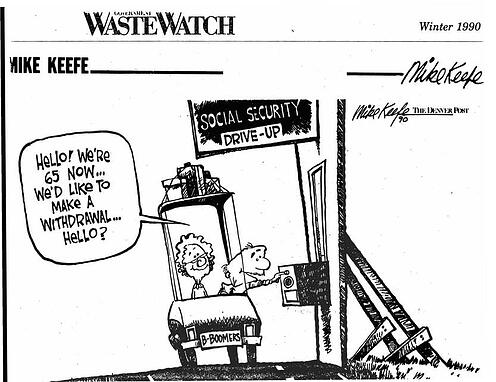
Social Security Cartoon 25A

At times, when I find a really good cartoon, I cut it out of the paper, like the one attached. This says drawn in winter 1990, 24 years ago when the baby boomers were in their early 40’s. Fast forward to 2014 and it seems nothing has changed!

So now, that we have established that Social Security will be there, now comes the question of how or when to take the benefit? There are several strategies to the challenge of maximizing the Social Security payment, while keeping the tax man at bay.

Here is one idea. Most people don’t know that they can “file and suspend”, meaning that they can file for the benefit and then immediately suspend receiving the benefit until they are a few years older. This strategy may be best used when one spouse has a higher income than the other. The spouse with the higher income files and immediately suspends receiving the benefit, while the lower-earning spouse files and receives half of the benefit.  While the one benefit is suspended it continues to grow until the suspension ends.  Once the higher-earning spouse reaches age 70, both can collect their own benefits in full.

While many people continue to work during the early years of retirement, they will want to watch how their income is paid to them so they can minimize the taxes on their Social Security. They may want to take money from their IRA’s first before receiving Social Security, thus reducing the taxable income from that source early on. This may help keep Social Security payments from being taxed if payments are put off for a few years.

How are you planning for your Social Security? Are you using any strategies to get the most benefit you can?

Topics: retirement, Social Security, Baby Boomers

120514_WWBrock_1

Wendell W. Brock, MBA, ChFC

Subscribe by Email

Follow Me

Most Popular Posts

Other Sites I Follow, hobbies, fun and info:

gold-vs-silver-1.jpg  Nauvoo Mint brokerage services for precious metals


john Mauldin chair

Note:

Outside Economics is not a registered investment advisory firm (RIA) and does not act as an RIA. Outside Economics does not provide any specific investment advice. Any information obtained from this website or through one of  Outside Economics' representatives should be reviewed by a professional.

Subscribers Note: We do not sell our email list. Period. Thank you for subscribing.

Recent Posts