Outside Economics

Social Security - When To Take It

Posted by Wendell Brock, MBA, ChFC on Thu, Jul 24, 2014

There is a great debate growing about when is the best time to start taking Social Security. There are pro's and con's on either side of the debate. But really, it all boils down to a very personal decision based on your specific situation.

Social Security Check

The factors of when to take Social Security depend on two considerations: 1) the quantitative information, your work status between age 62 and your full retirement age; your life expectancy; your marital status; and your desire to protect your assets; and 2) the qualitative information, what are your goals during retirement, when do you anticipate slowing down, will you have the stamina or interest to pursue things later in life, say, over age 80, etc. This will be a two part article, first I will discuss the quantitative factors how each of these may affect your personal situation, next week I will discuss, perhaps the more important, qualitative factors.

If you have not yet reached your full retirement age as defined by Social Security (for most people that's about age 66) and you are still working, it will probably not make sense to start receiving your Social Security benefits. Why? Because if you earn over the Social Security earnings limit, your Social Security benefits will be reduced. Once you reach full retirement age your benefits will not be reduced regardless of other income you may earn (although your benefits may be taxed.)

If you live to your standard life expectancy, believe it or not, you will get almost the same amount whether you take Social Security early, or wait until later to take it. To see how this works, it helps to look at an example using real numbers, such as the one below.

Steve is age 61 and he is deciding when to take social security. Here are the numbers from his Social Security statement showing what he will get at which age:

  • Age 62: $1,643 ($19,716 per year)
  • Age 66: $2,238 ($26,856 per year)
  • Age 70: $3,009 ($36,108 per year)

A 62 year old man has a life expectancy of nineteen years, or age 81. Social Security has a cost of living adjustment which provides an increase in benefit of 2% a year, but for now we’ll factor it without that. Here are the three possibilities:

  • Assume Steve starts receiving benefits at 62. He gets $1,643 per month, or $19,716 per year, for 19 years. This is a total of $374,600.
  • If he waits until age 66, he gets $2,238 per month, or $26,856 per year, for 15 years. He'll receive a total of $402,870.
  • If he waits until age 70, he gets $3,009 per month, or $36,108 per year, for 11 years. He'll receive a total of $397,190.

Clearly, if Steve lives to life expectancy, he maximizes his lifetime income by taking Social Security benefits at age 66. When you factor in the 2% annual increases, Steve would expect the following total amounts:

  • $450,320 if he started benefits at age 62
  • $502,720 if he started benefits at age 66
  • $514,800 if he started benefits at age 70

If Steve lives to age 81, he will maximize his lifetime income by waiting until age 70 to begin taking his Social Security benefits. In Steve's case, his break even age matches the average breakeven point which is 80, meaning if he waits until age 70 to begin benefits, he must live to at least age 80 to receive the same total dollars he would have received if he started taking benefits earlier. If you don't think you'll live past 80, you're better off claiming earlier. If you are married and think one of you will live past 80, it might make sense to delay.

Morningstar's Blanchett wrote a report, "When to claim Social Security" in The Journal of Personal Finance. He said "We find that females, married couples, retirees who expect to invest in relatively conservative portfolios during retirement, and retirees who have longer life expectancies are likely to benefit most from delaying Social Security benefits. On the other hand, retirees who have shorter life expectancies or invest more aggressively and believe they can achieve a relatively high return on their retirement portfolios would likely be better off taking Social Security earlier."

There are a lot of dollars at stake, and of course no one knows their life expectancy with certainty. However certain health and lifestyle factors will affect your own personal life expectancy. Just as an insurance company would do underwriting, I would suggest you do an analysis on your own personal life expectancy, using a life expectancy calculator that will ask you health and lifestyle related questions.

For singles, life expectancy is one of the primary factors to consider. For married couples, you have to consider more than just life expectancy. The way Social Security survivor benefits work, when you are married, upon the death of the first spouse, the surviving spouse can keep the larger of either their own benefit or their spouse's benefit. Because of this, there are ways for couples to coordinate how and when they each take benefits so they can get more as a couple.

I'm a strong believer in leaving an inheritance for my posterity. Using up retirement savings in lieu of potentially one day getting a larger Social Security check just doesn't achieve this goal. It makes more sense to use money that won't be there after I'm gone - i.e. Social Security - than to burn through things like cash savings, retirement account funds, and home equity. Personally, I'd rather try to save these assets, using Social Security (a source of income that I won't be able to pass on to descendants) to pay the bills rather than dipping into personal assets.

There are also a variety of strategies regarding Social Security. One is a switching strategy, which allows one spouse to claim another's benefits. For example, a married man who is 67 and doesn't need the benefits can claim his wife's benefits until he's 70, and let his own benefits continue to grow. When he turns 70, he can switch to his own benefits. Another switching strategy: A divorced woman who is 67 and had been married for at least 10 years can claim her ex-husband's benefits until she reaches 70, then switch to her own.

When to begin taking Social Security benefits is a very personal decision. Knowing the rules will help insure that you don't needlessly waste months of benefits that you could have received. If you have questions about when you should receive Social Security benefits, feel free to contact us for a free consultation. If you know of someone who may be at the threshold of this decision pass along this article to them, you may just save them some grief.

Note: Next week qualitative issues surrounding Social Security.

A Special thanks to Dan Perkins, PhD. who helped with these articles.
Topics: retirement, Social Security, Life Expectancy, Morningstar

Economic History - Lessons To Learn

Posted by Wendell Brock, MBA, ChFC on Thu, Jul 17, 2014

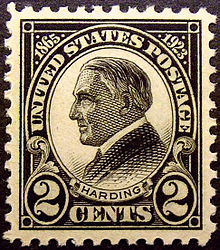
The Fed and the politicians as well as many modern economists featured in the main stream media continually hearken back to the Great Depression, as if that is the only time in history our country went through a decline in the economy. There have been other depressions that are noteworthy examples to compare and contrast with the Great Depression. Perhaps there is some instruction we can glean from the depression of 1920-21.220px Warren G Hardiing 1923 Issue 2c

This time period is continually ignored by the powers that be because it proves the absurdity of their policies. The conventional wisdom holds that without government countercyclical policy, whether fiscal or monetary (or both), we cannot expect economic recovery—at least, not without an intolerably long delay. Yet the very opposite policies were followed during the depression of 1920–21, and recovery was in fact quite swift.

That particular depression, although short lived, was as difficult and as steep in it's slump as that of the years of 1929-33. The simple difference is that it ended quickly. Here are some of the stats from that time period: From the spring of 1920 to summer 1921, nominal GDP fell by 23.9%, wholesale prices by 40.8% and the CPI by 8.3%. Unemployment topped out at about 14% from a preceding low of as little as 2%.

The depression also saw an extremely sharp decline in industrial production. From May 1920 to July 1921, automobile production declined by 60% and total industrial production by 30%. At the end of the recession, production quickly rebounded. Industrial production returned to its peak levels by October 1922. The AT&T Index of Industrial Productivity showed a decline of 29.4%, followed by an increase of 60.1% – by this measure, this depression of 1920–21 had the most severe decline and most robust recovery of any between 1899 and the Great Depression.

The climate was terrible for businesses – from 1919 to 1922 the rate of business failures tripled, climbing from 37 failures to 120 failures per every 10,000 businesses. Businesses that avoided bankruptcy saw a 75% decline in profits.

It is instructive, as well, to compare the American response in this period to that of Japan. In 1920, the Japanese government introduced the fundamentals of a planned economy, with the aim of keeping prices artificially high. According to economist Benjamin Anderson, “The great banks, the concentrated industries, and the government got together, destroyed the freedom of the markets, arrested the decline in commodity prices, and held the Japanese price level high above the receding world level for seven years. During these years Japan endured chronic industrial stagnation and at the end, in 1927, she had a banking crisis of such severity that many great branch bank systems went down, as well as many industries. It was a stupid policy. In the effort to avert losses on inventory representing one year’s production, Japan lost seven years.”

The U.S., by contrast, allowed its economy to readjust. “In 1920–21,” writes Anderson, “we took our losses, we readjusted our financial structure, we endured our depression, and in August 1921 we started up again. . . . The rally in business production and employment that started in August 1921 was soundly based on a drastic cleaning up of credit weakness, a drastic reduction in the costs of production, and on the free play of private enterprise. It was not based on governmental policy designed to make business good.”

Instead of “fiscal stimulus,” President Warren Harding cut the government’s budget nearly in half between 1920 and 1922. The rest of Harding’s approach was equally laissez-faire. Tax rates were slashed for all income groups. The national debt was reduced by one-third. The Federal Reserve’s activity, moreover, was hardly noticeable. As one economic historian puts it, “Despite the severity of the contraction, the Fed did not move to use its powers to turn the money supply around and fight the contraction.” By August of 1921, signs of recovery were already visible. The following year, unemployment was back down to 6.7 percent and was only 2.4 percent by 1923.

The federal government did not do what Keynesian economists ever since have urged it to do: run unbalanced budgets and prime the pump through increased expenditures. Rather, there prevailed the old-fashioned view that government should keep spending and taxation low and reduce the public debt.

Those were the economic themes of Warren Harding’s presidency. In his 1920 speech accepting the Republican presidential nomination, Harding declared:

“We will attempt intelligent and courageous deflation, and strike at government borrowing which enlarges the evil, and we will attack high cost of government with every energy and facility which attend Republican capacity. We promise that relief which will attend the halting of waste and extravagance, and the renewal of the practice of public economy, not alone because it will relieve tax burdens but because it will be an example to stimulate thrift and economy in private life.

“Let us call to all the people for thrift and economy, for denial and sacrifice if need be, for a nationwide drive against extravagance and luxury, to a recommittal to simplicity of living, to that prudent and normal plan of life which is the health of the republic. There hasn’t been a recovery from the waste and abnormalities of war since the story of mankind was first written, except through work and saving, through industry and denial, while needless spending and heedless extravagance have marked every decay in the history of nations.”

It is hardly necessary to point out that Harding’s counsel—delivered in the context of a speech to a political convention, no less—is the opposite of what the alleged experts urge upon us today. Inflation, increased government spending, and assaults on private savings combined with calls for consumer profligacy: such is the program for “recovery” in the twenty-first century.

Not surprisingly, many modern economists who have studied the depression of 1920–21 have been unable to explain how the recovery could have been so swift and sweeping even though the federal government and the Federal Reserve refrained from employing any of the macroeconomic tools—public works spending, government deficits, inflationary monetary policy, TARP, bailouts, QE—that conventional wisdom now recommends as the solution to economic slowdowns. The Keynesian economist Robert A. Gordon admitted that “government policy to moderate the depression and speed recovery was minimal. The Federal Reserve authorities were largely passive. . . . Despite the absence of a stimulative government policy, however, recovery was not long delayed.”

While there were many problems with Harding's presidency, his counsel applies to us today just as much as it did back back then. Sound fiscal policies, whether in government or in our homes require us to practice the principle of thrift and sacrifice; to learn to live a more simplified life, with less extravagance, and to live within our means.

What do you think about the solutions the Fed and the politicians are offering us today? Do you see ways we can return to the wisdom of the past? Join in the discussion with your comments.

Topics: Economy, Economists, Great Depression

Fixed Income Market - Simplified

Posted by Wendell Brock, MBA, ChFC on Thu, Jul 10, 2014

Recently, I came across a great explanation/story about how bonds worked and I added an element that explained how derivatives worked.  I have never had a drink, I think the story is rather funny simply because I have over the years been to many business parties where the booze flowed rather freely and I could imagine this sort of thing happening.DerivativeAlgorithmic Trading

Bond and Derivative Market

An Easily Understandable Explanation of Bond Markets

Heidi is the proprietor of a bar in Detroit. She realizes that virtually all of her customers are unemployed alcoholics and, as such, can no longer afford to patronize her bar. To solve this problem, she comes up with new marketing plan that allows her customers to drink now, but pay later. She keeps track of the drinks consumed on a ledger (thereby granting the customers loans).

Word gets around about Heidi's "drink now pay later" marketing strategy and, as a result, increasing numbers of customers flood into Heidi's bar. Soon she has the largest sales volume for any bar in Detroit.

By providing her customers' freedom from immediate payment demands, Heidi gets no resistance when, at regular intervals, she substantially increases her prices for whiskey and beer, the most consumed beverages. Consequently, Heidi's gross sales volume increases massively.

A young and dynamic vice-president at the local bank recognizes that these customer debts constitute valuable future assets and increases Heidi's borrowing limit. He sees no reason for any undue concern, since he has the debts of the unemployed alcoholics as collateral.

At the bank's corporate headquarters, expert traders transform these customer loans into DRINKBONDS, ALCOBONDS and PUKEBONDS. These securities are then bundled and traded on international security markets. Naive investors don't really understand that the securities being sold to them as AAA secured bonds are really the debts of unemployed alcoholics. Nevertheless, the bond prices continuously climb, and the securities soon become the hottest-selling items for some of the nation's leading brokerage houses.

Enter the derivatives… a derivative is basically an insurance policy on the bonds that buyers get to help insure that the bonds will one day pay off. These policies are traded too on the securities markets, however they are completely unregulated. Because the policy insures the bond it helps strengthen the bonds’ rating. The unregulated nature of the derivatives allows for the issuing company to extend its self beyond what typical capital requirements of other financial institutions, making these financial instruments extremely risky. (The greater the risk, the greater the reward; natural risk and return economics.)

For example a bank typically has a leverage ratio of 8-10 percent capital so for every $1,000.00 they lend they keep $80-100 or a ratio of 10:1 or 12:1 in what is called tier-one capital. However some of the derivatives were written by institutions whose capital level was extended to as much as 40:1 on up to 100:1; so they were keeping as little as $10.00 for each $1,000.00 they insured. Derivatives are not offered by your typical insurance companies.

Now for the rest of the story…

One day, even though the bond prices are still climbing, a risk manager at the original local bank decides that the time has come to demand payment on the debts incurred by the drinkers at Heidi's bar. He so informs Heidi.

Heidi then demands payment from her alcoholic patrons, but being unemployed alcoholics they cannot pay back their drinking debts. Since, Heidi cannot fulfill her loan obligations she is forced into bankruptcy. The bar closes and the eleven employees lose their jobs.

Overnight, DRINKBONDS, ALCOBONDS and PUKEBONDS drop in price by 90%. The collapsed bond asset value destroys the banks' liquidity and prevents it from issuing new loans, thus freezing credit and economic activity in the community.

The suppliers of Heidi's bar had granted her generous payment extensions and had invested their firms' pension funds in the various BOND securities. They find they are now faced with having to write off her bad debt and with losing over 90% of the presumed value of the bonds. Her whiskey supplier also claims bankruptcy, closing the doors on a family business that had endured for three generations. Her beer supplier is taken over by a competitor, who immediately closes the local plant and lays off 150 workers.

The size of the world derivative market, as of December 2013, is $710.182 Trillion; The world economy is $72-85 Trillion, the US economy is only $17.02 Trillion, it is an extremely big market!

The investors turn to the insurance companies who insured the bonds and demand that they too pay up, however because they did not keep enough capital to cover such large losses they implode and seek a bail out to keep from laying off thousands of employees and to keep the world markets open. After all without insurance on the bonds, no one would buy the bonds in the first place (even government bonds) and thus capital flows would completely stop. Totally crippling not just Heidi’s community of Detroit, but the world as we know it!

Fortunately though, the bank, the brokerage houses, insurance companies and their respective executives are saved and bailed out by a multi-billion dollar cash infusion from the Federal Reserve Bank and the Government.

The funds required for this bailout are obtained by new taxes levied on employed, middle-class, non-alcoholics.

If you want check if your portfolio holds derivatives let us know by clicking here.

Note: I could not find the original author of the story about Heidi's Bar to give proper credit; I added several paragraphs because the original story did not actually talk about derivatives - just bonds.

Topics: Bonds, Derivatives, Bailout

The Greatest Country on Earth - America

Posted by Wendell Brock, MBA, ChFC on Thu, Jul 03, 2014

Tomorrow is the 4th of July the day we celebrate as the day our great country was founded in 1776, when we declared our independence from England. I thought I would write a few of my feelings about our country. I was raised the youngest of seven children in Los Angeles, California. My parents met during World War II in Utah. My father was a photographer in the Signal Corps and in charge of the photographic departments on several bases west of the Rockies. My mother worked in one of those departments in Ogden.

I was raised with a great love for our country. My parents took this very seriously. As I learned more and more about our country’s history and founding my love grew. Having read many books on our founding fathers, Abraham Lincoln, and other presidents, I do have an appreciation and love of these great people.  When we spend time learning about the good in America we learn to love her.

Top of Mount WhitneyMy brother-in-law use to take me backpacking when I was a teenager in the High Sierras. There is no place like the High Sierras in the world (so I am told by the many people we met on the trail from other countries). The time spent there I learned again to love our country and its amazing beauty. I have traveled to many of the other states in the Union on business, and I am always amazed at what a wonderful country we have. It is truly special. I personally believe that God put all the right elements here so a nation could thrive and spread goodness throughout the world.

We have a constitution like no other country, with our republican form of government; yes we are a REPUBLIC, not a democracy. This constitution was the first in human history to declare that as individuals our rights came from the God who created us, not from a person or a government. These rights limited the government’s control over our lives and allowed us the freedom to develop ourselves as we chose.

military saluteWe have the world’s strongest best trained military. Now I know many people say we dwell too much on the military or spend too much on the military, etc. I have heard all of that, including we should not be in this country or that country, we should not be the world’s police force – we should just stay home and mind our own business. The reality of being the world’s police force is this, if we are not there to serve, some other super power will be called in to serve. So would we rather have China, Russia, or someone else in those countries? What would be the political frame work they would leave behind? Now I know that not everything is rosy with the military there are a few bad apples that commit crimes, etc. But by and large they are great people who serve and truly bless the lives of the people in those countries. An opportunity to help these struggling countries blesses everyone involved.

I have read several histories about the wars America has been involved in, I have visited several cemeteries where hundreds of thousands of soldiers are laid to rest. I have pondered on their lives being cut short by the conflict they were in, with deep gratitude I give thanks for their sacrifice and  the sacrifice of their families; I believe that the God of this land has a special place for them.

We have an amazing geography wherein we are able to produce food in abundance, like no other place on earth. Very few things won’t grow in America. What a great blessing to produce and eat so many different foods.

We have a country where people from other countries can become an American. Becoming an American is a very special thing and I would hope that all people who come would be contributors to this great country and not work to tear it down. We have so many people who wrongfully beat a negative drum that it is sad to see what they are missing. I would ask them to study deeply its history and learn about the people and hopefully they will discover what an amazing great country that God has blessed us with.

I could go on with many more things about the greatness of America, but time and space are limited. So I will invite you to find at least five of your favorite things about America and share them with your family and friends this weekend. Help others understand why you are grateful to be an American. And always ask God to continue to bless America.

Oh - and one more thing we have a great flag - I love our flag - long may she wave!

Topics: America, 4th of July, Independence day

Understanding Bitcoin

Posted by Wendell Brock, MBA, ChFC on Thu, Jun 26, 2014

Bitcoin is a payment system introduced as open-source software in 2009 by developer Satoshi Nakamoto. It is the first decentralized digital currency. Bitcoins are digital coins that can be sent through the internet.Bitcoin

The payments in the system are recorded in a public ledger using its own unit of account, which is also called bitcoin. Payments work peer-to-peer without going through a bank, a clearinghouse, a central repository or single administrator. This has led the US Treasury to call bitcoin a decentralized virtual currency. Although its status as a currency is disputed, media reports often refer to bitcoin as a cryptocurrency or digital currency.

Bitcoin promotes a number of advantages to it's use. Namely, the lack of a middleman via a bank or clearinghouse means lower fees. Bitcoin can be used throughout the world, in virtually every country. A bitcoin account can never be frozen. There are no prerequisites for using bitcoin and there are no arbitrary limits.

There are several currency exchanges that exist where people can buy bitcoins for dollars, Euros, etc. They can also be earned by what is termed mining. In mining, the bitcoins are created as a reward for the payment processing work associated with bitcoin in which miners verify and record payments into the public ledger. Besides mining, bitcoins can be obtained in exchange for products and services.

Bitcoins are stored in a digital wallet that can be accessed through a computer or mobile device. Sending bitcoins is as easy as sending an email. About 1,000 brick and mortar businesses were willing to accept payment in bitcoins as of November 2013 in addition to more than 35,000 online merchants.

The biggest problem with bitcoin seems to be in it's volatility. The price of bitcoins has gone through various cycles of appreciation and depreciation referred to by some as bubbles and busts. In 2011, the value of one bitcoin rapidly rose from about US$0.30 to US$32 before returning to US$2.

In the latter half of 2012 and during the 2012-2013 Cypriot Financial Crisis, the bitcoin price began to rise, reaching a peak of US$266 on 10 April 2013, before crashing to around US$50. As the people of Greece began to see their financial markets collapse, they sought out alternative ways to preserve their wealth and bitcoin was seen as a viable option.

At the end of 2013, the cost of one bitcoin rose to the all-round peak of US$1135, but fell to the price of US$693 three days later. In 2014 the price fell sharply, and as of April remained depressed at little more than half that of 2013.

Growth of the bitcoin supply is predefined by the bitcoin protocol. Currently there are over twelve million bitcoins in circulation with an approximate creation rate of 25 every ten minutes. The total supply is capped at an arbitrary limit of 21 million, and every four years the creation rate is halved. This means new bitcoins will continue to be released for more than a hundred years.

Bitcoin opens up a whole new platform for innovation. It provides access for everyone to a global market. Businesses have an advantage with using bitcoin as it minimizes transaction fees, there is no cost to start accepting them, it is easy to set up, and they get additional business from the bitcoin economy.

Bitcoin is an interesting currency, worth investigating. There are many pro's and con's to this as it is making it's way into a more prominent role in the financial world. There have been many innovations in many fields for many years. But innovations in the monetary system are long over-due. Perhaps bitcoin is the new competition that will prompt the Federal Reserve System and other central banks to operate sound policies.

Topics: Bitcoin, digital coins

Rising Interest Rates...

Posted by Wendell Brock, MBA, ChFC on Fri, Jun 20, 2014

In May, consumer prices posted their sharpest increase in 15 months as inflation continued a recent acceleration from unusually low levels. According to the Labor Department, the consumer price index jumped 0.4% after rising 0.3% in April. Economists had expected a 0.2% increase. Over the past 12 months, prices have increased 2.1%. Core inflation, which excludes the volatile food and energy categories, was up 0.3% last month the most since August 2011. And housing starts fell 6.5% in May.

Rising Interest RatesThe rise in prices was broad-based, with energy, food, housing, apparel and other costs among those increasing. Energy costs surged, with gasoline prices rising 0.7% and electricity costs increasing 2.3%. Food costs jumped 0.5%, the largest increase since August 2011, as meat, poultry fish and eggs rose 1.4% and fruits and vegetables rose 1.1%. Those categories have been rising for months, in part because of a drought in California, the huge loss of cattle herds from an early blizzard in the upper Midwest last fall, and a virus in the pork population.

Prices for goods other than food and energy also were up. Airline fares jumped 5.8%, the largest increase in 15 years. Apparel prices and housing costs both rose 0.3%. And an index of medical care costs increased 0.3% with prescription drug prices expanding by 0.7%. Last week, the Labor Dept. said that wholesale prices fell in May for the first time in three months.

The recent pick-up in consumer prices is generally considered good news for the economy because annual inflation was well below the Federal Reserve's 2% target last year. Low inflation reflects a weak economy and can lead to deflation, or falling wages and prices, which often foreshadows recession.

The unusually sharp rise in inflation last month could help prompt the Fed to begin to raise interest rates earlier in 2015 than expected or to increase rates more rapidly, especially if significant price increases continue. "The chances that (the Fed) will raise interest rates before the middle of next year are increasing," economist Paul Dales of Capital Economics said in a research note this month.

In planning for increasing interest rates, typically a person would invest in short-term instruments, these will have the lowest interest rates and least chance of principal loss. As they renew, they will renew at a higher rate. It is not a bad thing to look at other investments as well, but the whole portfolio should be structured in a way that it is well balanced, diversified, and has depth and breadth. Mutual funds and ETF’s can give you the depth, while a wide variety of those funds can provide the breadth.

Laddering bonds (bonds are purchased based on their duration over a period of time, for example purchasing each month a bond that expires in three years) is another strategy that when implemented can provide increasing rates – but again looking at short-term durations, typically nothing over three years, with something maturing monthly or quarterly.

Any of these strategic solutions also depends on how fast rates rise. If rates rise fast in a short period of time it can be difficult to manage, while a slow steady increase in rates is more manageable. However remember that rates at 25 basis points, which is a very low rate, increases to 50 basis points, still a very low rate; that is a 100 percent increase in the rate and is a very big move.

The years of low interest rates seem to be coming to an end. As investors, what does this mean for you? If you are close to retiring, this may influence you to re-think some of your investments. Bonds, equities, stock market, alternatives? What is the best route for your money?

Topics: CPI, Consumer Prices, Interest Rates, Core Inflation

Wellness Programs

Posted by Wendell Brock, MBA, ChFC on Fri, Jun 13, 2014

Outcome-based wellness programs are more popular than ever. Employers want to reward employees who take personal responsibility for their health. The obvious goal of the outcome-based wellness incentive approach for employers is to reduce medical costs. In addition to this, employers lose money when their employees are sick or injured, and other employees have to make up for their absence. It is in an employers best interest to encourage healthy behavior from their employees.

Healthy Fit Employees 3Recently, requirements for wellness programs were issued as a part of the Affordable Care Act (ACA). The main goal of these wellness regulations is to make sure employers do not use wellness programs as a way to discriminate. The regulations state that there are two types of wellness programs:  Participatory and Health Contingent.

A participatory wellness program functions in a way that the reward (or penalty) is based on participation only – so the average employee does not have to meet a health standard (e.g. blood pressure below a certain level).

A Health Contingent wellness program can be activity only or outcome-based. With the activity only option, there is a requirement to do some activity related to a health standard but the user is not required to meet a specific health standard. An example of this might be to require an employee to do exercise or follow a diet that can help reduce blood cholesterol.

For the outcome-based option, the user must attain or maintain a health standard such as body mass index, cholesterol, blood pressure, etc. or meet an alternative standard to qualify for an exemption.

Here are several elements to consider if a company offers a Health Contingent program: If an outcome-based program is used, one element is that a “reasonably designed program” must be provided to help the employee change their numbers and achieve the reward. These guidelines specify that the employer cannot require the employee to pay for this effort and the requirements must be practical. 

The ACA regulations state that there must be alternative ways to earn the reward or to have the standard waived altogether. A possible statement to help accomplish this might be: “Our goal is to help you be healthy by providing a wellness program that includes rewards! These rewards are available to all employees. If you think you might be unable to complete tasks required to earn a reward in the wellness program, contact us at (insert contact info) and we will work with you to modify the tasks so you can still qualify for the reward.” This statement could be included in your open enrollment materials. This statement in other words negates the “standard” because the programs standards can be modified for anyone who thinks they are special.

The requirements also counsel employers to use a Health Risk Appraisal that is HIPPA and GINA compliant. “Do not base incentives, health enrollment, eligibility, or benefits on genetic or family medical history information.”

Wellness programs that are just getting started should be a “participatory” wellness program for at least the first year. This means that employees should not be required to participate or to meet a health standard in order to qualify for benefits, etc. In other words, rewards should be based on participation in the wellness program and not on health screening data, personal medical history, or addictive behaviors.

The primary notion of an outcome-based incentive strategy is to offer rewards for healthy behaviors and penalties for unhealthy behaviors. But from a scientific perspective, is this approach effective? The Safeway case study is commonly cited to support the outcome-based approach because Safeway had a flat medical cost trend from 2005 to 2009 purportedly by tying employee health insurance premiums to outcome-based wellness incentives. However, Safeway's program began in 2008, making it an unlikely cause of the flat cost-trend between 2005 and 2009. The truth is, the evidence is fairly limited at this point.

Too many outcome-based strategies simply raise standards that must be met by employees to qualify for preferred rates without providing behavioral tools and skills to help employees adopt and maintain healthy behaviors. That is a little like requiring an employee to produce a business report without providing a desk or a computer. When an outcome-based strategy is paired with a well-designed wellness program that creates impact – you have a winning combination!

The key for employers then is to create a healthy culture by providing tools and skills to help employees change. This can be done in part by providing incentives. There are essentially two ways to provide incentives and both have one primary advantage and disadvantage.

Strategy number one is to reduce the employee portion of the premium every month, which is a good thing now but it creates complexity for HR, payroll, and/or benefits. Strategy number two is to reduce employee portion of co-pays and deductibles along the way (good thing later). This strategy comes with the advantage of administrative simplicity that HR, payroll, and benefits managers will love. Other incentive ideas include a discount or rebate of a premium or contribution; a waiver of all or part of a deductible, co-pay, or coinsurance; the absence of a surcharge; or the value of a benefit that would otherwise not be provided.

If the goal is to reduce medical costs, employee must make healthy life choices. The outcome-based wellness strategy is promising because it provides tools and skills to help create a culture of health coupled with incentives that encourage employees to change.

These programs are more complex and maybe difficult to implement due to the over-kill of ACA regulations. With a little paperwork and tracking; this type of a program can be instituted in small businesses as well, which can help the owners too, by providing extra benefits they can qualify for, thus making a fitness membership tax deductible. 

Topics: ACA, Affordable Care Act, Wellness Programs

More Problems: Foreign Account Tax Compliance Act (FATCA)

Posted by Wendell Brock, MBA, ChFC on Thu, Jun 05, 2014

A follow up from last week’s article about FBAR, the next hammer to drop is: The Foreign Account Tax Compliance Act, better known as FATCA, was passed in 2010 as part of the HIRE act. Which was supposed to start on July 1, 2014, but last week was postponed a second time until January 1, 2016, foreign financial institutions (FFI) will be required by the US government to report information regarding accounts of all US citizens – living in the US and abroad, US “persons”, green card holders and individuals holding certain US investments – to the IRS.

While the law’s full implementation mkeep calm and fatca on.jpegay be postponed, it does not mean that you do not need to be compliant with the law. The postponed implementation is most likely on the part of the FFI’s than on the American citizens complying with the reporting requirements of the law. So you need to report your foreign assets.

(A United States “person” includes U.S. citizens; U.S. residents; entities, including but not limited to, corporations, partnerships, or limited liability companies, created or organized in the United States or under the laws of the United States; and trusts or estates formed under the laws of the United States.)

This law requires foreign financial institutions such as local banks, stock brokers, hedge funds, insurance companies, trusts, etc., to report directly to the IRS all their clients who are US “persons.” FFIs that do not become compliant will be subject to a 30% withholding on their US investments when they are cashed in, which will directly impact FFI clients with US holdings.

FATCA requires financial institutions to use enhanced due diligence procedures to identify US persons who have invested in either non-US financial accounts or non-US entities. The intent behind FATCA is to keep US persons from hiding income and assets overseas. The key word here is “hiding”. Its O.K. to have assets over seas and follow that jurisdictions tax codes, but it’s not O.K. to “hide” those assets from the IRS.

The ability to align all key stakeholders, including operations, technology, risk, legal, and tax, are critical to successfully complying with FATCA. Both financial institutions and non-financial multinational corporations should consider steps such as:

  • Analyzing legal entity structures and registering FFIs that are required to register
  • Conducting gap analysis to identify systems and processes that must be updated
  • Develop an implementation plan for the changes required for FATCA compliance
  • Performing due diligence on preexisting account holders and re-mediate non-compliant accounts
  • Evaluating your controls related to FATCA compliance

FATCA also requires US citizens who have foreign financial assets in excess of $50,000 to report those assets every year on a new Form 8938 (FBAR) and may be filed with the 1040 tax return. The FBAR was discussed in more detail in a previous article.

This law is in essence making all the FFI’s in the world, similar to the US Banks, unemployed, unpaid IRS agents reporting on US citizens and their companies that may do business with their FFI.

Many Americans residing overseas are reporting banking lock-out. A number of foreign financial institutions have simply chosen to eliminate the accounts of US citizens and their US companies in order to minimize their exposure to FATCA reporting requirements, withholding fees and potential penalties. This is causing a lot of problems for US citizens and their companies doing business overseas.

The US Treasury/IRS has mandated the FFI’s use their Intergovernmental Agreements (IGAs); many countries have signed on and will facilitate the transfer of information. The IGA agreements include a non-discriminatory clause that is aimed at helping alleviate issues of lock-out of banking services to US citizens and US persons. In other words these FFI’s must be compliant or they will be placed on the IRS watch list and the FFI’s dollar assets could be impacted.

Many are calling this the “end of the dollar law” as many countries around the globe are looking to find alternatives to the dollar as the reserve currency to use when trading with their neighbor countries. This is one of the most overreaching laws the US Government has ever passed. In the end it appears to be a law that is doing more damage than good. As with all laws we never know the full ramifications until it is completely implemented, but this one was an easy one to spot that it would be bad, very bad for Americans the world over.

Topics: IRS, FBAR, FATCA, HIRE Act, Foreign Financial Institutions, US Citizens

Offshore Financial Accounts (FBAR) Requirements

Posted by Wendell Brock, MBA, ChFC on Thu, May 29, 2014

Often I am asked about offshore banking and setting up offshore accounts for people or companies, which I have done several times. However this is part of the education process – knowing what you have to report to the government for the privilege to move and protect some your assets off shore. Can it be done successfully? Absolutely. Can you save taxes? Absolutely. Can you protect your assets? Absolutely.

Foreign BankingWe all believe that our government has become so onerous that many people are leaving for other countries simply because Americans are not free anymore. A couple weeks ago I listened to David Barton speak and he said that if you “read 100 pages per day of all federal laws, seven days per week, it would only take you 25,000 years to complete the reading”. We are responsible to follow all those laws – ignorance is no excuse for breaking a law, right? Well here is another example of over-reach and being worked over by the federal government all in the name of protecting us against us. If you think you can hide your money some place, guess again…


Recently, new guidelines were released in a report of the Foreign Bank and Financial Accounts (FBAR). You need to know about these new guidelines if you have a financial interest in or signature authority over a foreign financial account, including a bank account, brokerage account, mutual fund, trust, or other type of foreign financial account that exceeds certain thresholds. The Bank Secrecy Act may require you to report the account yearly to the Internal Revenue Service.

The FBAR is a calendar year report and must be filed on or before June 30 of the year following the calendar year being reported. Effective July 1, 2013, the FBAR must be filed electronically through FinCEN’s BSA E-Filing System. (FinCEN stands for Financial Crimes Enforcement Network).

The FBAR is not filed with a federal tax return. A filing extension, granted by the IRS to file an income tax return, does not extend the time to file an FBAR. There is no provision to request an extension of time to file an FBAR.

            United States persons are required to file an FBAR if:

  1. The United States person had a financial interest in or signature authority over at least one financial account located outside of the United States; and
  2. The aggregate value of all foreign financial accounts exceeded $10,000 at any time during the calendar year to be reported.

(United States person includes U.S. citizens; U.S. residents; entities, including but not limited to, corporations, partnerships, or limited liability companies, created or organized in the United States or under the laws of the United States; and trusts or estates formed under the laws of the United States.)

There are some exceptions to the FBAR reporting requirements. They can be found in the FBAR instructions, but they include:

  • • Certain foreign financial accounts jointly owned by spouses;
  • • United States persons included in a consolidated FBAR;
  • • Correspondent/nostro accounts;
  • • Foreign financial accounts owned by a governmental entity;
  • • Foreign financial accounts owned by an international financial institution;
  • • IRA owners and beneficiaries;
  • • Participants in and beneficiaries of tax-qualified retirement plans;
  • • Certain individuals with signature authority over, but no financial interest in, a foreign financial account;
  • • Trust beneficiaries (but only if a U.S. person reports the account on an FBAR filed on behalf of the trust); and
  • • Foreign financial accounts maintained on a United States military banking facility.

A person who holds a foreign financial account may have a reporting obligation even though the account produces no taxable income. The reporting obligation is met by answering questions on a tax return about foreign accounts (for example, the questions about foreign accounts on Form 1040 Schedule B) and by filing an FBAR.

Just in case you were beginning to think perhaps you would just ignore all these forms and filing procedures, FinCEN does not mess around when it comes to penalizing non-filers. A person who is required to file an FBAR and fails to properly file a complete and correct FBAR may be subject to a civil penalty not to exceed $10,000 per violation for non-willful violations that are not due to reasonable cause. For willful violations, the penalty may be the greater of $100,000 or 50% of the balance in the account at the time of the violation, for each violation. There are exceptions to the penalties, such as when natural disasters occur that hinder timely filing. For guidance on those exceptions, see FinCEN guidance, FIN-2013-G002 (June 24, 2013).

FinCEN Notice 2013-1 extended the due date to June 30, 2015 for filing FBARs by certain individuals with signature authority over, but no financial interest in, foreign financial accounts of their employer or a closely related entity. 

Taxpayers with specified foreign financial assets that exceed certain thresholds must report those assets to the IRS on Form 8938, Statement of Specified Foreign Financial Assets, which is filed with an income tax return. The new Form 8938 filing requirement is in addition to the FBAR filing requirement.   

Last year there were a number of new forms introduced by FinCEN. FinCEN form 114 is the new FBAR form that is to be used in place of the old TD F 90-22.1 form. This form is designed to be an online form through the BSA E-Filing System website. Form 114a is a new form for filers who submit FBAR's jointly with spouses or who have a third party prepare their forms for them. It isn't submitted with the filing, but is kept back with the FBAR records maintained by the account owner in case FinCEN or the IRS requests them.   

The following educational products have been developed for your use in learning more about why, when and where to file the FBAR:

For further help feel free to call us and we can point you in the right direction. We are happy to provide you with outside professionals who can get you answers or other items needed to move and protect your assets properly, while staying compliant with the laws of the land.

Topics: FBAR, Foreign Bank Accounts, Offshore Banking, Asset Protection, Tax Savings

A Make Sense Investment Portfolio Strategy

Posted by Wendell Brock, MBA, ChFC on Wed, May 21, 2014

There are many theories on creating the best investment portfolio. Here is one that is well balanced, and well suited to surviving the financial fluctuations of these times. It is called the 7Twelve® portfolio. It was first formulated by Craig L. Isrealsen,PhD. an Executive-in-Residence in the Financial Planning Program in the Woodbury School of Business at Utah Valley University. Overall, he has over 25 years of experience in the financial industry.

Professor Isrealsen created this approach to maximize the benefits a diverse portfolio can offer. He likens this approach to a good salsa recipe. “The broad diversification of the 7Twelve® model is more important to its performance than picking the “right” funds. Very simply, the recipe is more important than the ingredients.”

Good ingredients + poor recipe = poor salsa/poor portfolio results

Good ingredients + good recipe = good salsa/good portfolio results

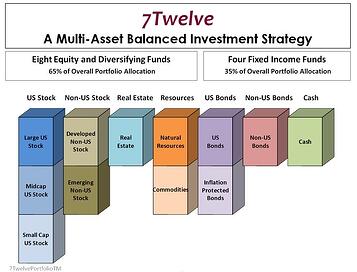
A 7Twelve® portfolio includes 7 core asset classes and consists of twelve different ETF’s or mutual funds (funds). Each of the twelve funds are equally weighted and the portfolio is periodically rebalanced to maintain an equally weighted structure.

Some of the benefits and objectives of the 7Twelve® portfolio include being able to produce long-term equity-like results with less volatility than equities. Compared to equities, this approach minimizes the frequency and the magnitude of losses thus delivering a more consistent performance over a rolling 3-year period of time. Maintaining a consistent portfolio with a philosophy of broad diversification will also help investors avoid fads and performance chasing.      

When assembling a balanced portfolio often its key elements are equities and fixed income assets. The seven core asset groups with their twelve associated funds are: US equity: large-cap US, mid-cap US, and small-cap US; Non-US equity: Non- US developed, and Non-US emerging market; Real Estate: global real estate; Resources: natural resources, and commodities; US bonds: aggregate US bonds, and inflation protected US bonds (TIPS); Non- US bonds: international bonds; and Cash: US money market.7Twelve 1

This arrangement will allocate 8 equity and diversifying funds- which is 65% of the overall portfolio, and 4 fixed income funds- which accounts for 35% of the portfolio. A 65/35 allocation balance will bring together more stability and less risk in a solid combination that, over the long haul, has a proven track record toward steady growth even in volatile times, such as we are experiencing now.

Each of the 12 funds is equally weighted at 8.33% of the portfolio. The equal-weighing is maintained by periodically re-balancing each of the 12 funds back to an 8.33% allocation. Quarterly or annual re-balancing generally produces the best performance, whereas monthly re-balancing is too frequent.

Re-balancing is an important part of the 7Twelve® investment strategy. Re-balancing helps to accomplish the goal of buy low and sell high. As sectors grow some is sold off to bring the portfolio into balance; the other sectors that are performing poorly get some new money to bring them up to the balanced amount. Nearly all sectors take their day in the sunshine, that of being the best performing asset. By keeping the portfolio balanced, each one is ready for their day to shine.

Re-balancing can also be done by simply adding new money to funds to re-create the 8.33% balance; or, if one is in their retirement years to simply withdraw money from the best performers whereby restoring the 8.33% balance.

Let’s face it, we are emotional creatures by nature, and most investors too are emotional about the decisions to buy or sell. Re-balancing is a fantastic tool that may help with the emotional roller coaster. Using systematic guidelines to monitor the portfolio increases the chance for success. Any assistance with the emotionally charged buy/sell decisions that may chip away at an investors overall gains is helpful. Trying to outsmart the market tends to do more harm than good; nobody can beat randomness at any given time. Having a steady plan to follow will help the investor to safely navigate the years it takes to grow their investment.

One of the main challenges of encouraging an investor to build a multi-asset portfolio is that the portfolio will never outperform the best performing individual asset class in any given year. Multi-asset portfolios are steady, not flashy. Nervous investors who are constantly looking over their shoulder may feel the need to chase last year’s best performing asset class and invest some or all of their portfolio into them. However, the winner last year is typically not the winner this year. This type of roller-coaster investing will surely lead to disaster.

Building a diversified portfolio is the only logical investment philosophy—both emotionally and mathematically. The emotional swings caused by chasing the performance of individual asset classes should be obvious, but the mathematics may not be.

The mathematical evidence supporting the wisdom of a steady multi-asset portfolio vs. performance chasing is simply put: asset classes that have huge gains also tend to also have large losses in subsequent years—and the math of gains and losses is NOT equal. For instance, a 50% loss requires a 100% gain to get back to the starting point.

Therefore, avoiding large losses is one of the key reasons for building a broadly diversified portfolio. Individual asset classes have great years (such as US stocks in 2013) but next year may not produce similar results. A steady, well diversified portfolio will win in the end. 

The 7Twelve® portfolio recipe for investing has a proven track record and is well worth looking into if you haven't already. Give us a call if you think this portfolio model will help you, and as always, do your own homework before you decide to invest.

______________

7Twelve is a registered Trade Mark by Craig Israelsen and is used by Wendell Brock by a licensing agreement.

Topics: 7Twelve, Investment Portfolio, asset classes, equities, Fixed Income, Craig Israelsen

120514_WWBrock_1

Wendell W. Brock, MBA, ChFC

Subscribe by Email

Follow Me

Most Popular Posts

Other Sites I Follow, hobbies, fun and info:

gold-vs-silver-1.jpg  Nauvoo Mint brokerage services for precious metals


john Mauldin chair

Note:

Outside Economics is not a registered investment advisory firm (RIA) and does not act as an RIA. Outside Economics does not provide any specific investment advice. Any information obtained from this website or through one of  Outside Economics' representatives should be reviewed by a professional.

Subscribers Note: We do not sell our email list. Period. Thank you for subscribing.

Recent Posts