Outside Economics

72.2 Earthquake - Brexit

Posted by Wendell Brock, MBA, ChFC on Fri, Jun 24, 2016

Fear and panic have hit the markets as if a massive earthquake hit the shores of the UK, as the Brexit vote has been tallied in favor of leaving the European Union (EU). The vote was very close, however most of the UK voted to leave. Scotland, North Ireland and London voted to stay. The vote was enough to send Prime Minister David Cameron to the podium to announce his resignation after the next party convention in October. The Pound Sterling was sent crashing to its lowest levels in 30 years, and other markets are reacting in a free-fall around the world.

1_EU_Final_Vote-1.pdf

Voter turnout was a record high of 72.2% passing the exit bill at 52% to 48% in favor of leaving the EU. 

So what does it all mean? What this means is a lot of changes, and markets do not like change, they like stability. The main change will be Britain will have its sovereignty back and will be allowed to make its own laws without the fear of the EU overturning those laws. 

This will come at a cost, the EU provided several benefits, namely the freedom of movement of people and goods and services. The 28 member states of the EU offered each country’s citizens to move freely between each country without a visa, people could travel freely, live, or work where ever they wanted in any EU country. Similar to the USA, where a person from California could move to New York and live and work there. 

A problem with the “free movement of people” was the refugee crisis, the people of the UK were feeling like their social system was already at max capacity and the EU was going to cram millions more people into the system. As refugees are brought into one EU country and processed, they then have free movement to all the countries and access to the jobs of those countries, along with new passports, etc. The UK felt this to be unwise for long-term political and social stability, since there was virtually no vetting of these immigrants.  

The UK will now have to renegotiate with each country the ability of its citizens to move about the EU. The Brits abroad may have to make applications to those countries they are currently living and working in to be able to stay, similar to any immigrant from another country. Or maybe they will come up with some grandfather clause to make it easier on those folks. 

The movement of goods and services will have to be renegotiated as well. The many products that are produced in the UK and moved about Europe freely without any tariffs or other import/export restrictions may change, some of those products may be replaced by other countries in the EU thus hurting British businesses.  

With the markets in a free-fall over this important vote, it may spell buying opportunities. Such political uncertainties always cause market turmoil, which spells opportunity. One headline this morning reads: Soros looks set to make a killing on Brexit result. 

Overall it will be hard to tell the from this vantage point the long term results of this vote, however, it will be a spectacle to watch as it unfolds around the world. The UK is a critical country on the world stage and one of our most important allies. Perhaps this will provide opportunity to make our relationship even stronger.

One thing we do know is the sun will rise on the UK again as it will the world over - a new day will dawn - its not the end yet! So keep calm and look for the good opportunities to work together and continue to make the world a better place.

 
REMEMBER:

“Try not to become a man of success but rather try to become a man of value.”  ~Albert Einstein

Our Inflation vs. Theirs

Posted by Wendell Brock, MBA, ChFC on Fri, Jun 17, 2016

Last week we looked at our inflation, now we will take a looks at what hyper inflation looks like  for one of our neighbors to the south. The price of oil has affected many economies around the world. It has hurt our economy in many ways, and helped in many other ways. But our economy is we diversified which is why the low price of oil has had such a balancing effect in our economy - other countries are not so blessed. 

One major oil exporter, Venezuela, is particularly hurting because of the low oil prices. As oil became the main income source, the country began to ignore other industries, like agriculture, and thus requires most of their food to be imported from Columbia and the United States. VenezuelaP57a-10Bolivares-1980_f-1-300x127.jpg

Before the 1950s agriculture was greater than 50 percent of Venezuela’s GDP, now it accounts for approximately five percent of GDP. This is a serious problem for the country’s leadership. As oil prices drop they are truly hurting. Its like still needing to feed the family on half the income; some things you can no longer afford and you don't have the economic base to find the income from other sources.

With oil exports accounting for over 95% of Venezuela’s revenue, the 50% collapse of oil prices in the past two years has thrown the country into fiscal and political turmoil. In order to raise critical cash to keep the government operational, officials have started to sell the country’s gold reserves. 

Even though the country is a major exporter of oil, it is also a major importer of essential goods for its citizens. The country’s currency, the bolivar, has collapsed to the value of one U.S. cent, creating hyperinflation which led to prices soaring over 121% in 2015, and expected to rise nearly 500% in 2016, as estimated by the IMF.

Inflation of this magnitude is similar to having a massive heart attack after twenty years of high blood pressure! It can really kill an economy!

In addition to its fiscal woes, the country is also suffering from little rain, which has brought about severe electricity shortages due to its main source of power generation, a dam whose water levels have dropped to historical lows. In late April, the country’s president ordered a two-day work week for government employees, in order to stem the consumption of electricity. The government workweek now is down to Mondays and Tuesdays, affecting roughly 2.6 million employees, representing 20% of the nation’s workforce.

Economic conditions have worsened, as the economy shrank 5.7% in 2015 and is projected to shrink another 8% in 2016, as estimated by the IMF. Such dire circumstances have created concern among U.S. officials, which are increasingly worried about an unraveling socialist economy and a political meltdown. Such an occurrence could lead to social unrest, chaos and political instability, causing tensions to rise with neighboring countries in South America.

So why is this important? Well hopefully two reasons: 1. perhaps it will bring about a political change, which will move the country back to a democracy and a free market economy and away from its current socialist/communist government. 2. hopefully they will begin to expand their industrial base and grow into other industries besides oil. Any time an economy is based on a single product the risk goes way up for future economic troubles.  

Additionally, it would be great for our two countries to get along better - geographically we are very close to Venezuela (less than 1400 miles) and the several people I know from Venezuela are wonderful people!

Sources: IMF


Remember:

There are plenty of good five cent cigars in the country. The trouble is they cost a quarter.
Franklin Pierce Adams


Topics: Economy, Oil, Inflation, Agriculture

Controlling That Old Dog: Inflation

Posted by Wendell Brock, MBA, ChFC on Thu, Jun 09, 2016

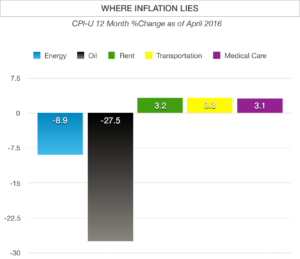
The Federal Reserve operates under a dual mandate, with three key objectives for monetary policy (which the Fed sets) to accomplish: Maximum employment, moderate long-term interest rates, and stable prices. Two of these three have been validated for the most part, with unemployment at 5%, and long term bond yields above short term bond yields. Stable prices (also known as inflation control) is monitored and released by the Consumer Price Index (CPI) each month and has been fairly subdued for sometime, until now. The Bureau of Labor Statistics which tracks the CPI reported that prices, as measured by the CPI, increased at the highest rate in three years as of April 2016. This latest report showed prices increasing at annual rate of 1.1%. 

A 1.1% inflation rate may not sound like much, but the data hidden within this number reveals something that the Fed may be concerned with. When broken down, the categories with the largest price increases nationwide were medical care services, transportation, and rent. What’s amazing is that the CPI increase would have been much higher if it wasn’t for the dramatic drop in energy and oil prices. Where-Inflation-Lies-1-300x259.png

The Fed considers various aspects of the economy and the country’s demographics when drafting its monetary policy. The fact that American’s are aging and are requiring more medical attention is an inflationary threat for retirees. In addition, many younger American’s are still having a very difficult time in securing mortgage loans, thus forcing young families to rent rather than buy. Such a dynamic has increased demand for rentals nationwide, forcing rents to rise until more supply is made available.

One cause of the medical inflation is the fact that Medicare, in an effort to control costs, continues to reduce payments to hospitals and doctors. The reduction in payments causes these businesses to look for other more profitable lines of business - meaning they stop seeing medicare patients altogether. This lowers the supply of services, thus raising the costs - it is simple economics. The additional problem is the enrollment in medical schools are down since the passing of Obamacare - meaning we are producing fewer doctors. 

While demand for rentals is high, so are sales of new homes. Housing is always challenging because of the time it takes to bring new home developments on line. The housing standards and regulations are so difficult, that it leaves fewer opportunities for low income housing. Gone are the days when a 1 bath, 3 bedrooms, 1000 square foot house is considered adequate. And yet for many first time home buyers maybe this is what the market needs (except I would opt for at least two bathrooms!).  

I think the next CPI report will have inflation at a much higher level, due to the recent large price increases in the energy sector. It is certainly affecting many people on the expense side, while at the same time it is good for the oil companies, who are starting to see a future in their business and maybe an opportunity to employ more people. 

It has been said that high blood pressure is a "silent killer"; Inflation is the silent killer of personal finances. Many may be asking how this will affect their investment portfolios and plans for retirement or issues with their own businesses. As inflation heats up, people need to be prepared. Helping people get prepared for these events are what I do - so if you want to be more prepared or you want a second opion on your current level of preparation call me for a no obligation free consultation. Click here for more information.

Sources: Bureau of Labor Statistics, Federal Reserve


Remember:

Inflation is one form of taxation that can be imposed without legislation.
Milton Friedman

Topics: Federal Reserve, Inflation

Bit Of What?  Bitcoin

Posted by Wendell Brock, MBA, ChFC on Fri, Jun 03, 2016

A new form of digital currency has received tremendous media coverage this past year, Bitcoin, which is essentially virtual money that is traded digitally by exchanges. Bitcoins can only be purchased and sold with legitimate currency, such as dollars or euros making it available worldwide. The total estimated value of Bitcoins worldwide is about 9 ½ billion dollars.

Bitcoins exist as software, not physical currency, and are not regulated by any country or banking authority. Even though U.S. Senate hearings disclosed that Bitcoin could be a means of exchange, it gave no assurance that it would actually become an accepted medium of exchange. Government regulations would need to be created and then enforced in order for Bitcoin to become accepted by other government entities. The currency can be traded without being tracked, thus raising the potential for illicit activity, such as involving weapons, drugs, and prostitution. Bitcoins are not illegal, but it is also not legally recognized by governments as a currency. bitcoin-image-small-file-1024x1024.jpg

In late December, the price of Bitcoins fell more than 50% from recent highs as the world's biggest bit coin exchange, BTC China, said it would stop allowing its customers to use the Chinese currency to buy the virtual currency. This in turn removed a big source of cash that had been fueling Bitcoin prices. At one point in November 2013, the price of one Bitcoin was almost identical to the price of one ounce of gold, both being valued at approximately $1200.

The price appreciation of Bitcoin has been a result of speculation, and hasn’t been used as a store of value or as a medium of exchange to any extent. Some compare Bitcoin to the tulip craze in Holland of 1637, when speculators pushed the price of tulip bulbs to incredible levels, followed then by a collapse in the tulip bulb market.

Bitcoin has surged on speculation that perhaps one day digital money will eventually become a legitimate global currency, and even replacing currencies from certain countries.

Bitcoins are mined by powerful computers that calculate complex, mathematical functions. Total Bitcoin quantity is capped at 21 million, and currently there are about 12 million that exist worldwide. Circulating physical coins only represent Bitcoin, and are not a store of value as is legitimate currency.

The growing mobile payment industry could be a big benefactor to the acceptance of Bitcoin, as new and creative applications are being devised to accept digital currency. Bitcoin transactions are very popular among mobile users, where rather than using a credit card or cash to make a purchase, all you’d need is your phone.

Bitcoins emerged in 2008 designed by a programmer or group of programmers under the name of Nakamoto, whose real identity remains unknown. New Bitcoins can only be created by solving complex math problems embedded in the currency keeping total growth limited.

The value of Bitcoins fell by about fifty percent in mid December following remarks by China and Norway to not recognize the digital currency as legal tender. The government of Norway ruled that Bitcoin does not qualify as real currency, but rather qualifies as an asset, producing taxable capital gains. Norway said that Bitcoins don’t fall under the normal definition of money or currency.

More and more nations have been taking an official stance as the popularity of Bitcoins has evolved. The European Banking Authority has warned about the risks of trading digital money and being subject to losses where consumers are not protected by any government entity or authority.

As digital currency evolves, some believe that it will eventually be accepted as a legitimate currency. But for the time being, others believe that its time hasn’t arrived yet. Various studies have recently emerged with different opinions, such as

a Stern School of Business study conducted by David Yermack, which concluded that Bitcoin behaves more like a speculative investment than a currency, and has no currency attributes at all. For additionall information on bitcoins read Understanding Bitcoin.


Sources: Bloomberg, Reuters


REMEMBER:

"What we plant in our subconscious mind and nourish with repetition and emotion will one day become reality" - Earl Nightningale

Topics: Gold, money, Bitcoin, Currency, taxable, digital currency, capital gains

Its Coming: Learn How to Respond

Posted by Wendell Brock, MBA, ChFC on Fri, May 27, 2016

With this being memorial day weekend perhaps it is appropriate to address the idea of mourning or grieving with those who have lost loved ones. So, what can you do when you or someone you know loses a family member or a close friend is a topic that I think everyone needs to pay attention to. Grief is real. It is intensely personal and can only be moved forward by the person feeling the loss. Helping someone through the grieving process is not instinctive and can be very hard - learn what you can so you can be of more assistance. memorial_day.jpg

Understanding this I thought I would relate a few personal examples. I am the youngest of seven children, five boys and two girls. My father passed away when I was 23 years old, I was single and in college. Fast forward nearly 30 years and my oldest daughter got married and the day after we arrived home, the first phone call was from a lady I had never met informing me that my very good friend and business partner had passed away from a heart attack the night before. There was a funeral to help plan and a elegy to write.

Within a span of 22 months I lost four people I was very close with, my close friend and  business partner, my brother-in-law, who was my best friend and help keep me on the right path as a teenager, we backpacked the John Muir Trail together; my oldest brother, who was my first business partner; and my angel mother, who continues to bless my life by her example of faith and strength. 

Considering my business of financial planning at times I have had to deal with the passing of a client or a family member and help people through the financial stresses of settling an estate (not probate). All the life insurance claims, filed changing accounts to the beneficiary, etc. The over-riding element others should express to those who are grieving is kindness.

Karen de la Cruz, Professor of Nursing says, “Researchers have suggested many grief models over the years, such as Elizabeth Kubler-Ross’s five stages of grief (denial, anger, bargaining, depression, acceptance), but these are just constructs for trying to make sense of an experience that usually doesn’t make much sense. And they can do harm when used to dictate how a person “ought” to grieve.”

de la Cruz continues, “The five stages are rough guidelines. They don't happen in order and they’re much more fluid than was originally thought. You can go back and forth between them, you can be in more than one stage at once, and not everyone goes through every stage.” 

“People grieve according to their own temperament, coping style, age or stage of life, relationship with the deceased, and previous experiences with death,” says de la Cruz.  

While there is no right way to grieve, there are wrong ways to treat those who are grieving. A friend who lost her father a week ago, commented that Monday night she was out with some friends and her boy friend, when someone happened to play a song that was played at her father’s funeral. She got a little teary eyed about and one of the fellows in the group said, “@#*^ life happens, get the @#*^ over it!” Clearly a horribly wrong thing to say. (Not to mention the fact that using foul language is inappropriate.) 

Sue Bergin’s, a hospice chaplain and bereavement counselor, for 10 years, shares a list of what to do and what not to do - to support grieving friends or family.

  • Don’t assume you have to talk. A hug or a squeeze of the hand can be more comforting than words.
  • Don’t tell your own grief story unless asked.
  • Don’t offer advice - of any kind.
  • Don’t assume that if someone has faith in the next life, they will have less need to grieve.
  • Don’t say things like “He’s in a better place” or “At least her suffering is over”. Any sentence that begins with the phrase “at least” is received as minimizing and isn’t comforting.
  • Don’t impose your personal beliefs about death and the afterlife on the griever.
  • Do give grievers your full, focused attention.
  • Do share your memories of the loved one and encourage grievers to share theirs.
  • Do invite grievers to short, low-intensity activities, such as a lunch, family home evening, or a walk or bike ride.
  • Do allow a griever to express his or her honest feelings, including anger at God and anger at the deceased.
  • Do share a book or other resource that has helped you with grief.”

I like this list, it provides some great counsel and clear thinking about what to do and what not to do. It reminds me of a talk I heard years ago by Sally Karioth, Ph.D., she said something to the effect, don’t say to the person “if there is anything I can do please just let me know?” The griever will never call and impose, after all often they don’t know what they need. She said the best thing is to “jump in and do something”… go mow their lawn if it needs it, bring them a bottle of soda pop, or a meal, clean their house, just don’t get in the way, try to do things that do not impose on the person too much as they need their space too. 

My favorite is to take or send a big bag of Peanut M&M’s with a note that says, “here is something to share when people come calling.” However you can show kindness and give a listening ear is best. I hope that we will all be a little more sensitive to those who have lost someone dear in this life. While this topic does not have much to do with economics, it does matter deeply to the people affected by a loss.

Source BYU Magazine


REMEMBER:

 "Empty pockets never held anyone back. Only empty heads and empty hearts can do that."  - Norman Vincent Peale


Topics: Grieving, Grief

My Tax Dollars Go Where?

Posted by Wendell Brock, MBA, ChFC on Fri, May 20, 2016

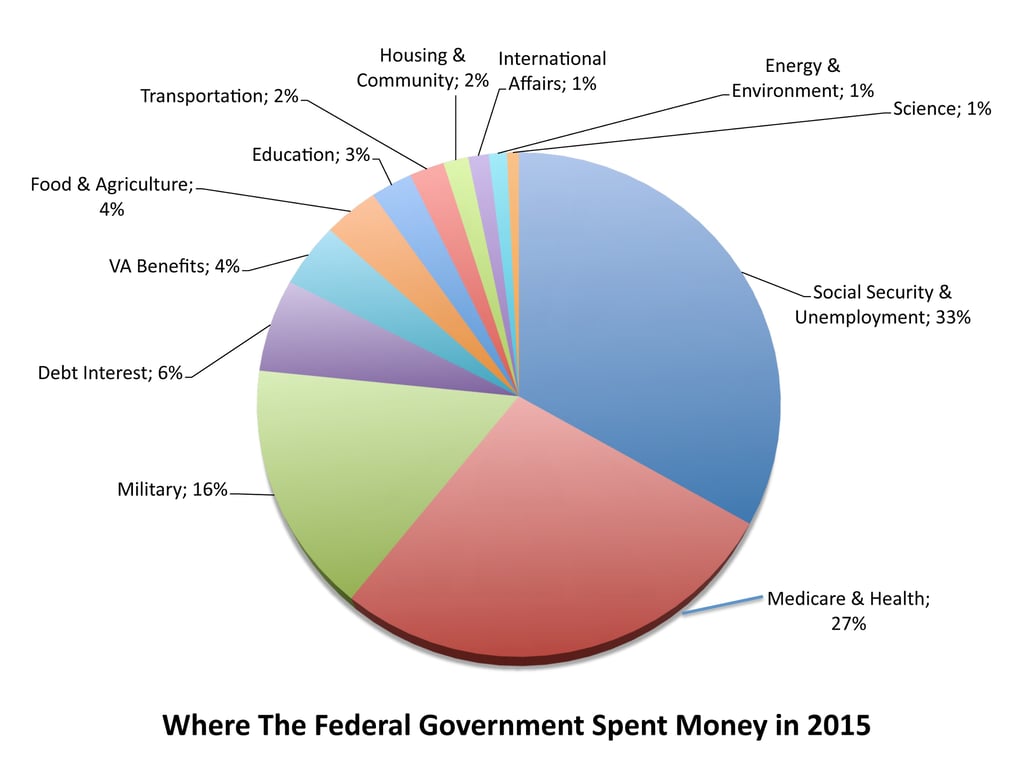
Now that you are recovering from the pain of settling your tax bill with the federal government, Taxpayers often wonder, where does all their tax money go? The Office of Management & Budget breaks down where tax payments go each year, allowing Americans to see what they’re getting.

For fiscal 2015, the federal government took in over $3.2 trillion in tax payments (that’s $3,200,000,000,000) a record year compared to previous fiscal years. The federal budget for fiscal year 2015 ran from October 1, 2014, to September 30, 2015. The total figure amounts to approximately $21,833 for every person in the United States. 

Federal-Spending-2015.jpgIts important to note that the what is paid in taxes and what the federal government budgets are two different numbers - the difference is the deficit and is borrowed from the federal reserve bank and other countries around the world. The 2015 deficit was $439 billion. While the 2015 deficit has come down from previous years, the total public debt continues to rise. The debt continues to rise because every year we add the current year’s debt to the pile already on the books. Bringing our total debt to over $14 trillion dollars today, which is clearly unsustainable. Our nation’s debt is at the level of our GDP - meaning that if we the public spent an entire year working and producing everything this country produces and paid 100% it on the debt we might pay it off, depending on interest rates.

Another area of spending that is interesting is federal civilian employees, their wages and benefits. I am never one to complain about what someone earns, after all that is the free market we live in, which I completely support. However, it takes a lot of tax payers to support just one federal worker. The average take home wages for federal employees are $83,034 per year. Benefits cost the tax payers another $35,532 per employee; bringing the total compensation for 2015, to $118,566 per employee. (These figures do not include the military.) This is quite a bit higher than the average american employee of the average american company.

The wage gap between federal employees and the private sector continues to grow according to the CATO Institute. Using 2014 numbers: federal employees earned an average of $84,153 and the average private sector employee earned only $56,350. When considering wages and benefits, the gap is larger: $119,934 for federal employees and $67,246 for private sector employees. I could not find the private sector earnings for 2015, but I don’t think they caught up to the federal employees compensation in one year. 

I remember as a teenager my father explaining to me why it was wrong for the federal government to allow federal employees to unionize. He explained that in the future wages would be out of control and that the employees of the federal government would stop being true public servants.    

The mandate to reign in federal spending and to balance the budget must be accomplished. We simply can’t go on for ever running up such deficits and incurring so much debt. Congress and the president must stand up and do what is right. Period. All of these little pet projects of a million here or a million there have been adding up and now they have caught up to create an uncontrollable flood of debt that soon will wash away everything in its path. We all need to stop hanging onto these pet projects and shutter a few federal agencies. 

And the public needs to learn more self-reliance so they can stop thinking they “need the federal government to solve all their problems.”

Source: Office of Management & Budget, CATO Institute


REMEMBER:

The penalty good men pay for indifference to public affairs is to be ruled by evil men. Attributed to Plato


Topics: self-reliance, tax dollars, Federal Government, tax payers

Want to Improve Your Credit Score

Posted by Wendell Brock, MBA, ChFC on Thu, May 12, 2016

The other day I was in a store that was having a closing sale nearly everything was 70% off. I struck up a conversation with the manager who was losing his job. I asked him about what he was going to do next. He told me that he had been with the company for 21 years and he was not sure, but he was going to just hang out until he decided and found the right opportunity. Then he said this, “when I learned that the two companies merged, and in the future there was a chance I might lose my job, my wife and I decided to get completely out of debt. So we have no debt and can live on very little.”  It was just over two years after the merger that we spoke and the store he managed was now closing. I though how insightful. I was thrilled to learn of another person who was debt free and had the freedom to choose what to do next.

Slavery-equals-debt-1024x676.jpgBecoming debt free should be a goal of each person. I have seen young college graduates who have finished school with well over $200,000 in student loans. As one client was telling me it is “discouraging”. The bondage of debt is discouraging! And what do many young graduates do - load up more debt and buy a new automobile! This debt can be extremely onerous! Read more about auto debt here.

This weeks article is mostly coming from a friend, Shawn Lane who is the Chief Operations Officer at Financial Renovations Solutions, (FRS). His company has helped many people improve their credit score and at the same time get more of their debt paid off. Being debt free greatly strengthens your financial position. Simply put, It is FREEDOM. 

Unfortunately some people find that they have slipped so much into debt that creditors start calling and some accounts get sent to collections. Shawn provides some answers in those difficult situations:


Will paying off a collection account improve my credit score?

I get this question a lot. Although I would never suggest NOT paying your debts, you need to be very careful when paying a collection account. If you are 100% sure you owe it, then maybe you should pay it (more on this later). However, if your goal is to improve your credit score, paying it will likely have the opposite, negative effect.

The FICO scoring model treats collection accounts as closed accounts, and the balance on these accounts have no impact on your credit score. What matters most is “the date of last activity”, which is the date the original debt went bad, or the date of your last payment to the collection agency. This means that a $150 collection account from last month has more negative impact to your credit score than a $3,000 collection account from last year. Therefore, paying it will not increase your credit score. In fact, often times paying it will drop your credit score even more by creating new and more recent activity on this account. 

Further, paying a collection account does NOT remove it from your credit report. You end up spending your money and reducing your credit score.

If you plan to pay a collection account, first secure an agreement with the collection agency to remove the entire collection account from your credit report upon receipt of payment. Better yet, make them first prove you owe the debt by sending them a debt validation letter AND make the credit bureaus prove they are reporting the account 100% accurately on your credit report. If they can’t prove it, they must remove it! Utilize the Fair Credit Reporting Act and the Fair Debt Collection Practices Act, as these protect consumers like you and me! You will have a very good chance of getting the account deleted from your credit report, which WILL increase your credit score.

I know Shawn has worked with people all over and is straight up honest in what he does. He truly cares about his clients. If you would like to contact him, click here, he will provide a free consultation. Everyone of us knows someone who needs help with their debts, pass this article on to them, you never know what will really flip a switch with someone. I wish you the best of luck in obtaining real freedom, by becoming debt free.


Remember:

"Continuous effort - not strength or intelligence - is the key to unlocking our potential." ~ Winston Churchill


Topics: debt, credit score, debt free, freedom, collections

People Who Are Still Breathing NEED This

Posted by Wendell Brock, MBA, ChFC on Thu, May 05, 2016

Two weeks ago the world lost a very talented musician, Prince. While I must admit I have never been much of a fan of his work, or some genres of most modern musicians, he was amazingly talented. And I am sad for his family's loss. He was young - only 57 years old - young by society’s standards where we routinely expect people to live active lives into their 80's and maybe into their 90's. 

Prince is estimated to have amassed a large estate between $300 to $500 million. This was news to me as I had no idea how large his estate was. I think this is fantastic. For those who know me I thrill at learning of people's successes in life, however they define their success. That is one reason I love what I do - helping people achieve success with their financial goals, whatever they may be.

Back to Prince. I was surprised to learn that he died with no personal estate plan. He chose to use the one the State of Minnesota had planned in their estate laws instead - he died “intestate” (without a will). Now this is simply crazy! This is the example of why everyone needs at least a will, and should have a personal estate plan prepared by a real estate planning attorney.

probate-court.jpgNow it is estimated that approximately 55% (40% federal and 15% state) of his estate will go off in estate taxes. Think about this, he worked from a young age (teenager) practicing the guitar to become a world famous musician, amass a large estate because of his successful use of his talent, only to pay huge income taxes all his life and then the final rub to pay another 55% when he passes away. That works out to be $165,000,000 to $275,000,000 paid to the government (state and federal)! 

Not to mention that his estate maybe tied up in probate court for years to come. What a nightmare for his family!

Here is a person who could easily afford the best advice possible from the sharpest legal minds in our country, but chose not to do so. Clearly he had attorneys who helped review his contracts and other investment advisors who helped him manage his money. It saddens me to think not one of them sat him down and said someday you will die, you should be prepared. Perhaps they tried to do this and he ignored them, like many young people who think they will live forever.

Those of you who are young - or better yet those of you who are still breathing, young or old - need a valid estate plan. Not one referenced by the drive by financial planners, self-prepared on some internet website for $29.99. Don't create problems for those you leave behind - go see a real attorney who specializes in estate planning and get it done right.

Now you may be saying I am not wealthy like Prince; that is not the point everyone needs an estate plan if you own a home, cars, business, or any other assets, you need a plan. Besides a will or trust a proper estate plan also includes certain documents needed while you are still living, like a Medical Power of Attorney, a Living Will,  and other documents. 

If you are part of a second marriage, you need an estate plan. I have personally seen a father disinherit his children and grandchildren and everything went to the second wife, completely different from his wishes. These things happen all too often. If you don’t know of a good estate planning attorney you can I can provide you with more information I know several. I wish you all the best in the proper planning for the future disposition of your hard earned assets. 


REMEMBER:

"Death is not the end. There remains the litigation over the estate" ~ Ambrose Bierce

Topics: Estate Planning, Will, Trust, probate

Here Goes California - More Government Control

Posted by Wendell Brock, MBA, ChFC on Fri, Apr 29, 2016

With a population of 38 million people, California maintains the single largest cluster of hourly workers of all 50 states at over 9.1 million workers, per U.S. Labor Department data released in 2015 . According to Kevin De Leon, president pro tempore of the California state senate, about 5.6 million Californians, representing roughly 32% of the state’s workforce, currently live on the minimum wage.

CA_Flag.pngCalifornia’s current statewide minimum wage of $10 per hour is already among the highest in the country. The state of New York is also considering raising its minimum wage to $15 per hour, where fast food restaurants are already subject to a $15 per hour minimum.

Both houses of California’s state legislature passed a measure to raise the wage on March 31st. California’s current minimum wage is set at $10 an hour. Under the measures, increases would start in 2017 with a $0.50 hike to $10.50 an hour. This would be followed by another $0.50 raise in 2018, and then annual $1.00 increases through 2022.

Individual cities and counties may also impose their own minimum rates, such as Los Angeles which will be increasing its minimum to $15 per hour by 2020.

Nationally, the federal minimum wage has not increased since 2009 and is currently set at $7.25 an hour, yet 29 states and D.C. have higher minimums.

For over 74 years, workers in the United States have been granted a minimum wage level for their benefit. An initial attempt to establish a minimum level for wages occurred in 1933, when a depression era mandate set a wage minimum at 25 cents per hour ($4.10 in 2012 dollars). The National Industrial Recovery Act, which was the act that the initial wage evolved from, was declared unconstitutional by the Supreme Court in 1935.

In 1938, the minimum wage was re-established successfully under the Fair Labor Standards Act. The act held ground because the Supreme Court noted that Congress had the power under the Commerce Clause to regulate employment conditions. Since then, a minimum wage has always been in place and enforced nationally.

The Fair Labor Standards Act sets federal minimum wage standards, while state governments set state minimum wages. While some states have higher minimum wage standards than federal law, others have the same rate or none at all. Where federal and state laws have different minimum wage rates, the higher standard (wage) applies.

Some states don’t impose a minimum wage and just let employers abide by the federal standards. Alabama, Louisiana, Mississippi, South Carolina, and Tennessee currently have no minimum wage.

Sources: U.S. Bureau of Labor Statistics: Characteristics Minimum Wage Workers 2014 Table 3, Released 2015; www.senate.ca.gov

 
REMEMBER:


“Try not to become a man of success but rather try to become a man of value.”

~Albert Einstein


Topics: Economy, Minimum Wage

Stop Keeping Old Income Tax Info

Posted by Wendell Brock, MBA, ChFC on Fri, Apr 22, 2016

Things can get a bit crazy at tax time, there is so much information to keep track of and provide to the preparer (CPA or Enrolled Agent - EA) or IRS. As we make our way through the piles and files of receipts and statements left over from tax time, disposing of some of these obstacles is a thought. It is always suggested to carefully shred documents containing any critically sensitive information.

paperwork.jpgThe idea is to toss out what you don’t need anymore, yet keep what you might need for income taxes and accounting purposes. Here are some items that accumulate the most with a note as to how long to keep them:



Monthly Utility Statements - can be disposed of after three months unless the expenses are being written off for tax purposes, then you may want to maintain those until after tax time.

Pay Stubs – having the most recent pay stub handy is suggested, with no need to keep older stubs since the most recent stub should contain all YTD details. Should you be applying for a loan or mortgage, then having as much as one year’s stubs available is helpful.

Credit Card Receipts & Statements – can be tossed when the credit card statement is received and reviewed. If using a credit card for business purposes, then keeping receipts for seven years is the recommended time period. Statements on the other hand should be kept for three months should there be a dispute or chargeback of an expense.

Canceled Checks – can be shredded once the bank statement arrives. Credit card receipts and business related expenses should be kept for seven years. Most people don’t get their canceled checks back any more, but if a photo copy comes with the bank statement treat these the same as a canceled check.

Bank Statements – are possibly the most important items to keep for an extended period. Like pay stubs, if a loan or mortgage application is in process, six to twelve months of statements is what most lenders are asking for nowadays.

Insurance – always replace outdated policies and coverage verifications with the most recent and keep in an accessible place should a claim need to be filed.

Medical Statements, Bills & Insurance Notices – should be kept for at least five years especially if these items are used as tax deductions and even lingering insurance payment claims. With the onslaught of recent health care initiatives, it is wise to track and file all medical related items as detailed as possible.

Tax Returns & Supporting Items - should be kept at least seven years. Supporting documents include receipts, mileage logs, spreadsheets, paid invoices and canceled checks.

For business owners, this is a good time to “clean house” and get rid of  old information (back eight years) get rid of that box or file of receipts and tax returns. That would be seven years for the tax return filed (2015 - 7 years = 2008) So throwing away stuff from 2007 should be safe.

After selecting all the stuff to get rid of, I think it is just easier to shred it all. Here is why: 1) you may have inadvertently left an important document in the stack to throw out, this way you know everything is destroyed properly. 2) the shredded paper is easier to recycle. 3) it also makes a good fire starter for your next camping trip! Having burned up a couple shredders in the past its worth the money to get a good one.

It is also a good time to check tax planning for the year, don't wait until year end to plan - are you on track? Learn some new tax rule changes, and a couple big income tax problems for this year. Good luck cleaning House!


REMEMBER:

The income tax has made liars out of more Americans than golf. - Will Rogers

120514_WWBrock_1

Wendell W. Brock, MBA, ChFC

Subscribe by Email

Follow Me

Most Popular Posts

Other Sites I Follow, hobbies, fun and info:

gold-vs-silver-1.jpg  Nauvoo Mint brokerage services for precious metals


john Mauldin chair

Note:

Outside Economics is not a registered investment advisory firm (RIA) and does not act as an RIA. Outside Economics does not provide any specific investment advice. Any information obtained from this website or through one of  Outside Economics' representatives should be reviewed by a professional.

Subscribers Note: We do not sell our email list. Period. Thank you for subscribing.

Recent Posts